
IELTS Academic Reading: How to Handle Long Passages in 60 Minutes


You have exactly 60 minutes. In that hour, you must navigate three dense, academic texts totaling roughly 2,700 words and answer 40 complex questions. For many test-takers, the struggle isn’t necessarily understanding the English language, but rather the sheer pressure of the clock. Mastering IELTS academic reading time management is often the deciding factor between a candidate who achieves a Band 6.5 and one who sails through with a Band 8.5. Without a concrete plan, it is incredibly easy to get lost in the intricate details of a passage and leave ten questions unanswered as the examiner calls for pens down.
The Academic Reading module is designed to test your ability to quickly identify key information, understand logical arguments, and recognize the writer’s opinions. Because the texts are taken from journals, books, and magazines, they often contain specialized vocabulary and complex sentence structures. If you approach this test like you would a novel—reading every word from start to finish—you will almost certainly run out of time. To succeed, you need to transition from a “reader” to a “strategist.”
In this comprehensive guide, we will break down the most effective methods for IELTS academic reading time management, explore the difference between skimming and scanning, and provide you with a step-by-step framework to ensure you never leave a question blank again. Whether you are just starting your preparation or are looking to shave those final few minutes off your practice tests, these expert strategies from Simply IELTS will transform your approach to the exam.
Why Time Is the Biggest Challenge in IELTS Academic Reading
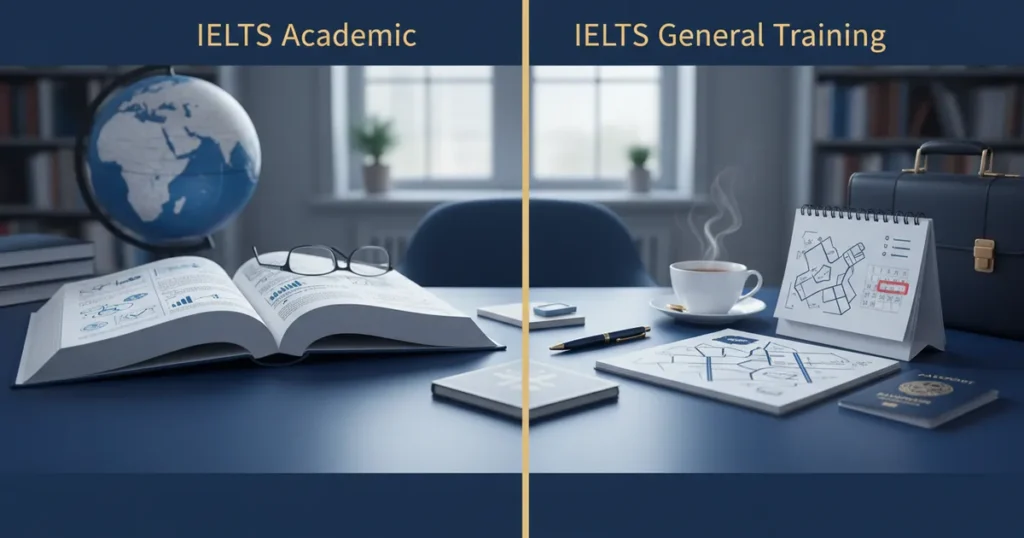
The primary reason students struggle with time is the “Academic” nature of the texts. Unlike the General Training module, which focuses on everyday contexts, the Academic module uses sophisticated language. If you are unsure which version you should be taking, our IELTS Academic vs General Training: Complete Comparison Guide 2026 provides a detailed breakdown of the differences.
In the Academic version, the passages are progressively difficult. Passage 1 is generally considered the most straightforward, while Passage 3 often contains more abstract concepts and complex arguments. Candidates often make the mistake of spending an equal 20 minutes on each passage. However, because the difficulty increases, this “flat” time distribution can lead to a panic-induced finish. Effective IELTS academic reading time management requires a more dynamic approach that accounts for the rising complexity of the tasks.
Furthermore, the variety of question types—ranging from Matching Headings to True, False, Not Given—requires different cognitive shifts. Switching between these tasks consumes mental energy and time. If you don’t have a systematic way to handle these transitions, you’ll find yourself rereading the same paragraph four or five times without finding the answer.
The Core of IELTS Academic Reading Time Management: Skim vs. Scan
To master the clock, you must master the two most important tools in your reading arsenal: skimming and scanning. These are not just buzzwords; they are the foundation of high-speed information processing.
Skimming for the “Gist”
Skimming involves reading a text quickly to get a general overview of the content. You aren’t looking for specific details yet; you are trying to understand the “map” of the passage. When you skim, you should focus on the title, the subheadings, and the first and last sentences of each paragraph. This helps you identify where specific topics are discussed, which is vital for questions like Matching Headings. You should spend no more than 2-3 minutes skimming a passage before looking at the questions.
Scanning for Specifics
Scanning is the technique used when you know exactly what you are looking for. This could be a date, a name, a specific technical term, or a keyword found in the question. Your eyes should move rapidly over the page, ignoring everything except the target word. Scanning is particularly effective for Sentence Completion tasks where you need to find a specific noun or number to fill a gap.
The greatest mistake students make is reading the passage first and the questions second. In the IELTS Academic Reading test, the questions are your guide; the passage is merely the resource. Use the questions to tell you what to scan for, and use the passage only to find those answers.
Lead Instructor, Simply IELTS
Strategic Time Allocation: The 15-20-25 Rule
While the official IELTS Official Website suggests spending 20 minutes per passage, many top-scoring students find that a graduated approach works better for IELTS academic reading time management. Because Passage 3 is the most difficult, you should aim to “bank” time from the earlier sections.
| Passage Number | Difficulty Level | Recommended Time | Goal |
|---|---|---|---|
| Passage 1 | Easy / Moderate | 15 Minutes | Accuracy and Speed |
| Passage 2 | Moderate / Hard | 20 Minutes | Steady Progress |
| Passage 3 | Hard / Complex | 25 Minutes | Deep Analysis |
By completing Passage 1 in 15 minutes, you give yourself a 5-minute cushion for the final, most challenging section. This extra time is often needed to decipher the figurative language or nuanced arguments typically found at the end of the test. Remember, your goal is to reach the required number of correct answers for your target band score. You can check how many correct answers you need using our IELTS Reading Score Chart 2026.
Handling Different Question Types Efficiently
Different questions require different amounts of time. Efficient IELTS academic reading time management involves recognizing which questions to tackle first and which might require more time.
The “In-Order” Questions
Questions like Multiple Choice, True/False/Not Given, and Sentence Completion usually follow the order of the text. This is a huge time-saver. Once you find the answer to Question 1, you know that Question 2 will be further down. If you are struggling with True False Not Given, always remember that the information is sequential.
The “Global” Questions
Matching Headings or Matching Information questions do not follow the order of the text. These are the most time-consuming tasks. If a passage has both Matching Headings and Sentence Completion, do the Sentence Completion first. Why? Because by the time you have finished the Sentence Completion, you will have read much of the passage, making it much faster to match the headings later.
Pro Tip: Sentence Completion Speed
When working on Sentence Completion, always check the word limit (e.g., “NO MORE THAN TWO WORDS”). This prevents you from wasting time considering answers that are grammatically correct but technically invalid.
What to Do When You Get Stuck
One of the biggest killers of IELTS academic reading time management is the “stubbornness trap.” This is when a candidate refuses to move on until they have found a specific answer. They might spend 4 or 5 minutes on a single question, which is a disaster for their overall score.
- The 1-Minute Rule: If you haven’t found the answer or even the relevant paragraph within 60-90 seconds, mark the question, make an educated guess, and move on.
- Keyword Analysis: If you can’t find a keyword, it’s likely been paraphrased. Instead of looking for “global warming,” look for “rising temperatures” or “climatic shifts.” Building your vocabulary is essential for recognizing these synonyms.
- The “Not Given” Trap: In True/False/Not Given questions, if you have spent 2 minutes looking for information and it’s nowhere to be found, it is highly likely “Not Given.” Don’t waste time looking for something that isn’t there.
Practice Drills to Improve Your Speed
Reading speed is a muscle that needs to be trained. You cannot expect to have perfect IELTS academic reading time management on exam day if you haven’t practiced under pressure. Here is a drill you can use during your preparation:
- The 15-Minute Sprint: Take a standard IELTS passage (like the one found in our Bats to the Rescue lesson) and set a timer for 15 minutes. Try to answer all 13-14 questions. Don’t worry about accuracy at first; focus on finishing.
- The Keyword Hunt: Take a passage and a list of 10 keywords from the questions. Set a timer for 2 minutes and see how many of those keywords you can locate in the text.
- The Summary Challenge: Read a paragraph in 30 seconds and write a 5-word summary. This builds your ability to skim for the main idea, which is vital for Matching Headings.
For more structured practice, consider enrolling in our IELTS Reading Course, which provides timed simulations and expert feedback on your performance.
How to Build Long-Term Reading Stamina
While techniques are important, your underlying reading speed is determined by your familiarity with English. If you have to translate every third word in your head, your IELTS academic reading time management will suffer regardless of your strategy.
To build stamina, you should read high-level English materials daily. Sources like The Economist, New Scientist, and National Geographic are excellent because they mirror the style and tone of the IELTS. As you read, practice identifying the main argument of each article. If you encounter difficult texts about extinct animals, for example, practicing with specific exams like The Thylacine — IELTS Reading can help you get used to the scientific vocabulary used in the test.
Additionally, don’t neglect your writing skills. Understanding how an academic essay is structured can help you predict where information will be in a reading passage. For instance, learning how to describe bar charts or taking our IELTS Academic Writing Task 1 Course teaches you how data is presented—a skill that is directly transferable to the Reading module’s table and chart completion questions.
Common Time-Wasting Habits to Avoid
Even with the best IELTS academic reading time management, certain habits can drain your clock. Be mindful of these during your practice sessions:
- Sub-vocalizing: This is the habit of “saying” the words in your head as you read. This limits your reading speed to the speed of your speech. Try to visualize the meaning rather than “hearing” the words.
- Regression: This is when your eyes skip back to reread a sentence you just finished. Trust your first pass. If you didn’t understand a sentence, it might not even be relevant to the questions.
- Over-thinking: The IELTS is a literal test. Don’t look for deep, hidden meanings. If the text says “most people,” and the question says “everyone,” the answer is False. Don’t argue with the text; just report what it says.
- Transferring Answers Late: Unlike the Listening test, you do NOT get extra time to transfer your answers to the answer sheet in the Reading test. You must write your answers directly onto the sheet within the 60 minutes. A good strategy is to transfer your answers after each passage.
Conclusion: Taking Control of the Clock
Mastering IELTS academic reading time management is a journey from being an overwhelmed reader to a precise, tactical examiner. By implementing the 15-20-25 minute rule, prioritizing question types, and refining your skimming and scanning skills, you can turn the 60-minute limit from a threat into a structured framework for success.
Remember, the goal of the IELTS Reading test isn’t to learn about the history of the Thylacine or the benefits of bats; it is to demonstrate that you can handle complex information efficiently. Don’t let a single difficult paragraph derail your entire performance. Stay disciplined, keep moving, and use the resources available at Simply IELTS to sharpen your skills.
Ready to put these strategies into practice? Start by taking our comprehensive IELTS Reading Course or dive into our library of vocabulary building lessons to ensure you have the linguistic foundation to match your new time management strategies. Your Band 8 is waiting—take control of the clock today!





Responses