
Describe a Puzzle you Have Played — IELTS Speaking Cue Card (Band 9 Sample Answer)

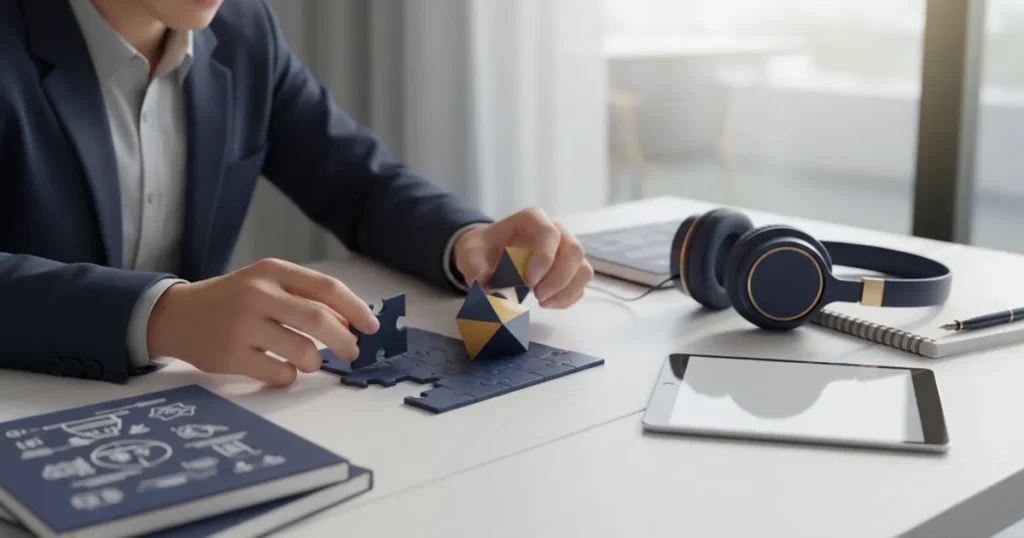
In this post, we will explore a high-scoring approach to the IELTS Speaking test, specifically focusing on how to describe a puzzle you have played. This particular prompt has become a frequent feature in recent exams, and by studying the Band 9 model answer provided below, you can learn how to structure your response for maximum impact and fluency.
The Cue Card
Describe a puzzle you have played.
You should say:
• What it was
• When and where you played it
• How you played it
and explain how you felt about playing this puzzle.
Band 9 Sample Answer
I’d like to talk about a rather daunting 2,000-piece jigsaw puzzle that I tackled during the winter break last year while I was staying at my family’s cabin in the mountains. The puzzle itself was a sprawling landscape of the Swiss Alps, featuring incredibly intricate details of snow-capped peaks, a crystal-clear turquoise lake, and a tiny, colorful village nestled in the valley. It was actually a gift from my sister, who knows I have a bit of a penchant for challenging brain-teasers. I set it up on a massive dining table that we rarely used, and it basically stayed there for the better part of two weeks. To be honest, the process was quite meticulous; I started by painstakingly sorting all the edge pieces to create the frame, which is my standard operating procedure for jigsaws. However, the real struggle began with the sky—it was just a vast expanse of nearly identical blue and white shades. I spent hours hunched over the table, using a trial-and-error approach to see which jagged edges would finally click together. There were moments of genuine frustration when I felt like a piece was missing, but the sense of accomplishment I felt whenever a difficult section finally took shape was incredibly rewarding. It became a sort of meditative ritual for me; every morning, I’d grab a cup of coffee and lose myself in the tiny patterns and textures. By the time I placed the final piece—the tiny golden bell on a mountain goat—I felt an immense wave of satisfaction. It wasn’t just about finishing a game; it was about the patience and persistence required to see such a complex project through to the end, which was a refreshing change from the instant gratification of digital life.
Band 7 Sample Answer
I want to describe a puzzle I played recently, which was a Sudoku puzzle in a magazine. I played it last month while I was traveling on a long train journey to visit my cousins. I usually find train rides a bit boring, so I bought a puzzle book at the station to keep myself busy. This specific Sudoku was marked as “expert level,” so it was quite hard for me. To play it, I had to fill a nine-by-nine grid with numbers so that each row, column, and section contained the digits one to nine without repeating. I used a pencil because I made a lot of mistakes at the beginning. It took me about forty minutes to finish the whole thing. I felt very happy and proud when I finally solved it because I usually give up on difficult math-related puzzles. It helped the time pass much faster, and it felt like a good workout for my brain. I think puzzles like this are great because they don’t require any special equipment, just a pen and some concentration. Since then, I have started doing one Sudoku every morning to stay sharp.
How the Band 9 Answer Scores Top Marks
Fluency and Coherence
The Band 9 response flows naturally without any unnatural hesitations or “robotic” transitions. The speaker uses cohesive devices like “to be honest,” “however,” and “by the time I…” to link ideas logically. The narrative structure follows a clear chronological path—from receiving the puzzle to the process of solving it and finally the emotional conclusion. This mirrors the high standards expected in the General Overview of IELTS Speaking Test, where logical progression is key to a high score.
Lexical Resource
The vocabulary is sophisticated and topic-specific. Instead of saying “hard,” the speaker uses “daunting” and “meticulous.” Instead of “doing,” they use “tackled” or “painstakingly sorting.” Idiomatic expressions like “penchant for,” “standard operating procedure,” and “lose myself in” demonstrate a high level of English mastery. This variety of vocabulary is what separates a Band 9 from a Band 7. It is similar to how you might describe a prize that you received using words like “prestigious” or “coveted.”
Grammatical Range and Accuracy
The answer showcases a wide range of complex structures. The speaker uses the past continuous (“while I was staying”), past perfect (“had to stay”), and even conditional-style logic (“whenever a difficult section finally took shape”). The use of relative clauses, such as “featuring incredibly intricate details,” adds depth to the descriptions. For more help with these structures, you should check out the IELTS English Speaking Course which breaks down complex grammar for the exam.
Pronunciation
While the text cannot show sound, the choice of words suggests a speaker who can handle multi-syllabic terms like “gratification,” “meticulous,” and “persistence” with ease. In a real exam, the rhythmic stress on words like “immense wave of satisfaction” would convey the speaker’s emotions effectively, which is a hallmark of Band 9 pronunciation. You can find more Speaking Tips on our site to improve your intonation.
Vocabulary and Idioms to Use
| Word/Phrase | Meaning | Example Sentence |
|---|---|---|
| Intricate | Very complicated or detailed. | The puzzle had an intricate design that made it hard to solve. |
| Meticulous | Showing great attention to detail; very careful. | Sorting the pieces was a meticulous task that took hours. |
| Trial and error | Trying various means until one succeeds. | I solved the difficult section through trial and error. |
| Brain-teaser | A problem or puzzle, typically one designed to be solved for amusement. | I’ve always loved a good brain-teaser to keep my mind active. |
| To be engrossed in | To give all your attention to something. | I was so engrossed in the puzzle that I forgot to eat lunch. |
| Spatial reasoning | The ability to think about objects in three dimensions. | Jigsaw puzzles are great for improving your spatial reasoning. |
| Sense of accomplishment | A proud feeling of having done something difficult. | Finishing the 1,000-piece set gave me a huge sense of accomplishment. |
| To piece together | To assemble something from various parts. | It took me weeks to piece together the entire landscape. |
| Mentally stimulating | Something that makes you think or use your brain. | I find Sudoku far more mentally stimulating than watching TV. |
| Mind-boggling | Overwhelming; startling; or very confusing. | The sheer number of blue pieces was mind-boggling. |
| Therapeutic | Helping you to relax or feel better. | I find the repetitive motion of fitting pieces together quite therapeutic. |
| Perseverance | Persistence in doing something despite difficulty. | Solving a complex puzzle requires a great deal of perseverance. |
Grammar Structures That Boost Your Band Score
- Past Perfect for sequence: “I had never attempted such a large puzzle until my sister bought me this one.”
- Relative Clauses: “The village, which was located in the bottom left corner, was the easiest part to solve.”
- Gerunds as subjects: “Sorting the pieces by color is the most efficient way to start.”
- Third Conditional (Hypothetical): “If I hadn’t found the corner pieces first, I would have struggled much more.”
- Used to / Would: “When I was a child, I would spend every Sunday doing crosswords with my grandfather.”
- Passive Voice: “The final piece was finally placed after three hours of searching.”
- Modals of Deduction: “It must have been incredibly difficult to design such a complex pattern.”
Part 3 Follow-up Questions
Why do some people enjoy doing puzzles while others find them boring?
I believe it boils down to individual temperament and how people prefer to stimulate their brains. For some, the process of solving a puzzle is deeply therapeutic and provides a sense of order in a chaotic world. These individuals often enjoy the “flow state” that comes with deep concentration. On the other hand, people with a more high-energy or results-oriented personality might find the slow, meticulous nature of puzzles tedious. They might prefer activities that offer more immediate feedback or physical movement. It’s also worth noting that some see puzzles as a lonely endeavor, whereas others view them as a peaceful escape from social pressures.
Do you think puzzles are beneficial for children’s cognitive development?
Absolutely. Puzzles are fundamental tools for early childhood development. They help in honing spatial awareness and fine motor skills as children learn to manipulate small pieces into specific slots. Furthermore, puzzles teach vital “soft skills” like patience and perseverance. When a child encounters a piece that doesn’t fit, they have to manage their frustration and try a different approach, which builds problem-solving resilience. It’s much like how learning about a new subject, such as when you describe an area of science that interests you, requires logical steps and building blocks of knowledge.
How have digital puzzles changed the way people engage with this hobby?
Digitalization has made puzzles far more accessible and varied. You no longer need a large physical space to spread out a thousand pieces; you can simply open an app on your phone. This has led to a surge in “casual gaming,” where people solve quick puzzles during their commute. However, there is a trade-off. Digital puzzles often lack the tactile satisfaction of physical ones. There is something uniquely rewarding about the “click” of two cardboard pieces fitting together that a touch screen simply cannot replicate. Additionally, digital puzzles can sometimes be distracting due to ads or notifications, which might break the concentration required for a truly mentally stimulating experience.
Are puzzles more popular now than they were in the past?
It’s interesting because while traditional hobbies often decline in the face of technology, puzzles have seen a massive resurgence, particularly during the global lockdowns a few years ago. People were looking for screen-free activities to pass the time and reduce stress. Furthermore, the variety of puzzles has expanded—we now have 3D wooden puzzles, escape-room-style board games, and complex logic apps. So, while the format has changed, the underlying human desire to solve problems and find patterns remains as strong as ever. They have become a staple of modern “slow living” movements.
Is it better to solve puzzles alone or as a group activity?
Both approaches have their merits. Solving a puzzle alone is a wonderful way to practice mindfulness and self-reflection; it allows for total concentration without any external interruptions. However, doing a puzzle as a group, perhaps with family or an interesting neighbor, turns it into a collaborative social event. It encourages communication and teamwork as different people spot different patterns. In a group setting, the sense of accomplishment is shared, which can strengthen bonds. Personally, I think the “best” way depends on your mood—sometimes you need the quiet, and sometimes you want the company.
Common Mistakes to Avoid
- Being too brief: Don’t just say “I played a puzzle and it was fun.” Use descriptive adjectives to paint a picture for the examiner.
- Focusing only on the “what”: The prompt asks how you felt. Make sure to spend enough time discussing your emotions and the mental challenge.
- Repetitive vocabulary: Avoid using the word “puzzle” in every sentence. Use synonyms like “jigsaw,” “brain-teaser,” “grid,” or “challenge.”
- Ignoring the bullet points: While you can talk about other things, the bullet points are there to help you. If you skip “where you played it,” you might lose points for coherence.
- Over-complicating the story: You don’t need a life-changing event. A simple story about a Sudoku on a bus is fine, as long as the language you use is high-level.
Practice Tips for This Cue Card
- Visualize the puzzle: Before you speak, spend 10 seconds imagining the colors, the shape of the pieces, and the table you were sitting at. This makes your description more concrete.
- Record yourself: Use your phone to record a 2-minute answer. Listen back and check if you used any of the “Vocabulary and Idioms” from the table above.
- Practice transitions: Use a timer and practice moving from the description of the puzzle to the explanation of your feelings smoothly.
- Expand your Part 3 answers: Don’t just give one-sentence answers. Try to use the “Area-Example-Reason” structure to extend your responses.
- Check the latest trends: Stay updated with the IELTS Speaking Topics Jan–Apr 2026 to see if “puzzles” or “games” are still in the current rotation.
Mastering the ability to describe a puzzle you have played is all about balancing technical description with personal reflection. By using advanced vocabulary and varied grammatical structures, you can demonstrate to the examiner that you have the fluency required for a top band score. For more practice and detailed feedback, consider enrolling in our IELTS English Speaking Course or visiting the official IELTS website for more test-day information.





Responses