
IELTS Grammar: Common Article Mistakes and How to Fix Them


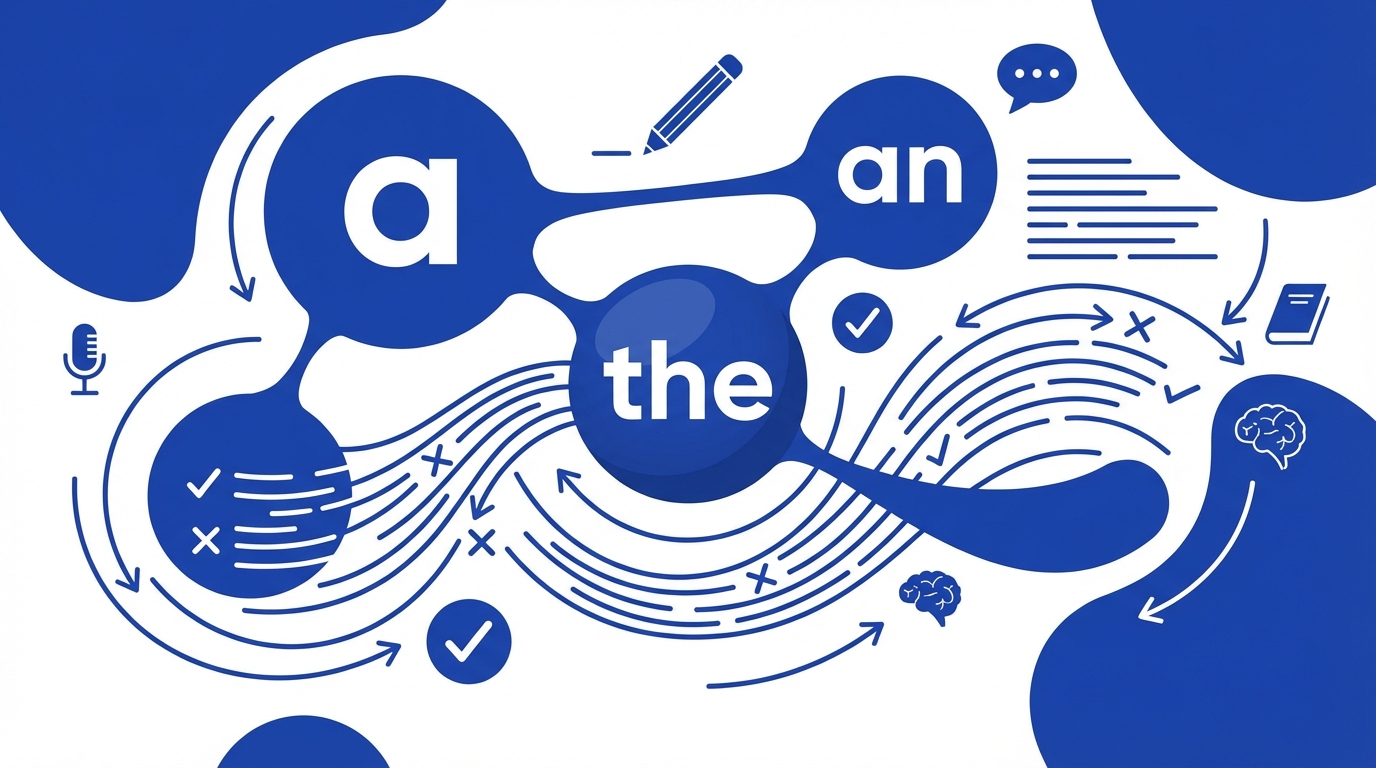
The “Invisible” Score Killer
Okay, let’s be honest for a second. When you’re studying for the IELTS, articles—those tiny little words “a”, “an”, and “the”—probably aren’t at the top of your worry list. You’re likely stressing about complex vocabulary, tricky reading passages, or what on earth you’re going to say about “transportation in the future” for two minutes straight.
But here’s the thing: after correcting thousands of essays (and listening to just as many speaking tests), I can tell you that articles are often the difference between a Band 6.0 and a Band 7.0.
Why? Because misuse of articles is what we call a “frequent error”. Even if your vocabulary is stunning and your ideas are brilliant, missing “the” or adding “a” where it doesn’t belong signals to the examiner that your control of grammar isn’t quite precise yet.
Sound familiar? Don’t worry. It’s incredibly common, especially if your first language doesn’t use articles the same way English does. Today, we’re going to fix this. Not with boring textbook rules, but with practical tips that actually make sense.
The Golden Rule: Specific vs. General
Before we dive into the mistakes, let’s simplify the whole system. Forget the 50 different rules for a moment. Most article usage comes down to one question:
Are you talking about ANY one, or THAT specific one?
- A/An (Indefinite): One of many. You don’t care which one. “I need a pen.” (Any pen will do).
- The (Definite): A specific one. We both know which one. “Give me the pen on the table.” (That specific pen).
- No Article (Zero Article): General things in the plural or uncountable. “Pens are useful.” (All pens in the world).
Keep this in mind as we go through the common traps.
Mistake #1: The Missing Article Before Singular Nouns
This is the most common error I see in IELTS Writing Task 2 essays. In English, a singular countable noun simply cannot stand alone. It needs a minder—a determiner.
Wrong: “Student should study hard.”
Right: “A student should study hard.” (Any student)
Right: “The student should study hard.” (A specific student we mentioned before)
Right: “Students should study hard.” (Plural—often the best choice for essays!)
Pro Tip: When you’re making general statements in your essays (like “Governments should…” or “Teachers often…”), use the plural form with no article. It’s much safer and usually sounds more natural than trying to use “the government” or “a teacher”.
Mistake #2: The “Over-The” Syndrome
I call this the “Over-The” syndrome because some students think adding “the” makes their writing sound more formal or academic. It usually does the opposite.
We generally do not use “the” with:
- Abstract nouns relating to concepts: “Education is important” (Not “The education”). “Society faces challenges” (Not “The society”).
- Most countries: “I live in China” (Not “The China”).
- Languages: “I speak English” (Not “The English”).
Exceptions (because English loves exceptions):
We DO use “the” with countries that are collections or unions, like The UK, The USA, The Philippines, or The Netherlands. Also, if you use the word “language”, you need “the”: “The English language”.
If you’re unsure, check a reliable dictionary like the Cambridge Dictionary for specific usage.
Mistake #3: Referring Back (The “Second Mention” Rule)
This one is crucial for coherence, which is 25% of your writing score. When you introduce something for the first time, use “a/an”. When you mention it again, use “the”.
Example:
“Yesterday, I bought a book. The book is about IELTS preparation.”
Why? Because the first time, it was just “a book” (one of many). The second time, it’s specific—it’s the one I just told you about. Using this correctly helps your ideas flow logically, which is exactly what examiners are looking for.
You can find more on improving your grammar score in our guide to the best IELTS grammar books.
Mistake #4: The “Hospital/School/Prison” Confusion
This is a tricky one that often trips up even advanced learners. With places like school, university, prison, hospital, or church, the meaning changes depending on “the”.
- No article: You are there for the purpose of the building.
- “He goes to school.” (He is a student).
- “She is in hospital.” (She is a patient).
- With “the”: You are referring to the building itself.
- “He went to the school to pick up his son.” (He’s not a student; he’s just visiting the building).
- “I work at the hospital.” (Specific building).
For your IELTS Speaking test, this comes up a lot when talking about your background. “I go to university” is usually what you mean, not “I go to the university”.
Quick Quiz: Can You Spot the Errors?
Let’s put this into practice. Look at these three sentences. Which ones are correct?
- “Pollution is big problem in world.”
- “The pollution is a big problem in the world.”
- “Pollution is a big problem in the world.”
(Think about it for a second…)
Answer: Sentence 3 is correct.
– “Pollution” is uncountable and general here, so no “the”.
– “Problem” is a singular countable noun, so it needs “a”.
– “World” is unique (there’s only one relevant to us!), so it takes “the”.
How to Practise This
You don’t need to spend hours doing grammar drills. Instead, try this active reading technique:
Take a reading passage from a practice test or a reputable article. Go through one paragraph and circle every “the” and “a”. Ask yourself why it’s there. Why did the writer choose “a” instead of “the”? Why is there no article before “society”?
Doing this for just 5 minutes a day will rewire your brain to notice these patterns naturally. You can start with our ultimate study guide or any British Council learning resource.
And remember, aiming for perfection is great, but communication comes first. If you slip up on an article, don’t panic. Correct yourself if you notice it immediately, or just keep going. Fluency matters too!
If you’re planning your preparation timeline, don’t forget to check our 7-day study plan to see where grammar fits into your schedule.
You’ve got this!






Responses