
IELTS for Beginners 2026: Where to Start Your Preparation Journey



Stepping into the world of international English testing can feel like navigating a complex maze, especially as we look toward the evolving landscape of 2026. If you are a newcomer to this high-stakes exam, understanding ielts for beginners 2026: where to start your preparation journey is the most critical first step you will take. The International English Language Testing System (IELTS) remains the gold standard for global migration and higher education, but the strategies required to succeed are shifting as digital testing becomes the norm and examiner expectations refine.
Starting your journey isn’t just about buying a textbook; it’s about diagnostic self-assessment, understanding the nuances between the Academic and General Training modules, and building a sustainable study habit. In this comprehensive guide, we will break down the barriers for beginners, providing a clear, step-by-step roadmap to achieving your target band score in 2026. Whether you are aiming for a university in the UK, a job in Canada, or residency in Australia, the path to success begins with a solid foundation.
As an expert instructor at Simply IELTs, I have seen thousands of students transform from confused beginners to confident test-takers. The secret isn’t just “studying harder”—it’s studying smarter by aligning your preparation with the specific criteria that examiners look for. If you are ready to take control of your future, let’s explore the essential starting points for your 2026 IELTS adventure.
Quick Answer: ielts for beginners 2026: where to start your preparation journey
The shortest route to starting your IELTS journey in 2026 involves three immediate actions: First, determine which version of the test you need (Academic for study, General Training for work/migration). Second, take a full-length diagnostic practice test to identify your current “base” band score. Third, familiarize yourself with the four modules—Listening, Reading, Writing, and Speaking—and their specific time limits. By identifying your weaknesses early, you can create a targeted study plan rather than wasting months on topics you already master. If you are looking for specific IELTS exam dates 2026, plan at least three to four months of preparation before your chosen date.
Detailed Explanation: Understanding the 2026 IELTS Landscape
By 2026, the IELTS exam has fully embraced the “Digital First” approach. While paper-based tests are still available in many regions, the Computer-Delivered IELTS (CDI) is now the preferred choice for its faster results and more frequent testing windows. For a beginner, this means your preparation must include digital literacy—learning to type quickly, highlight text on a screen, and navigate digital interfaces comfortably.
Academic vs. General Training
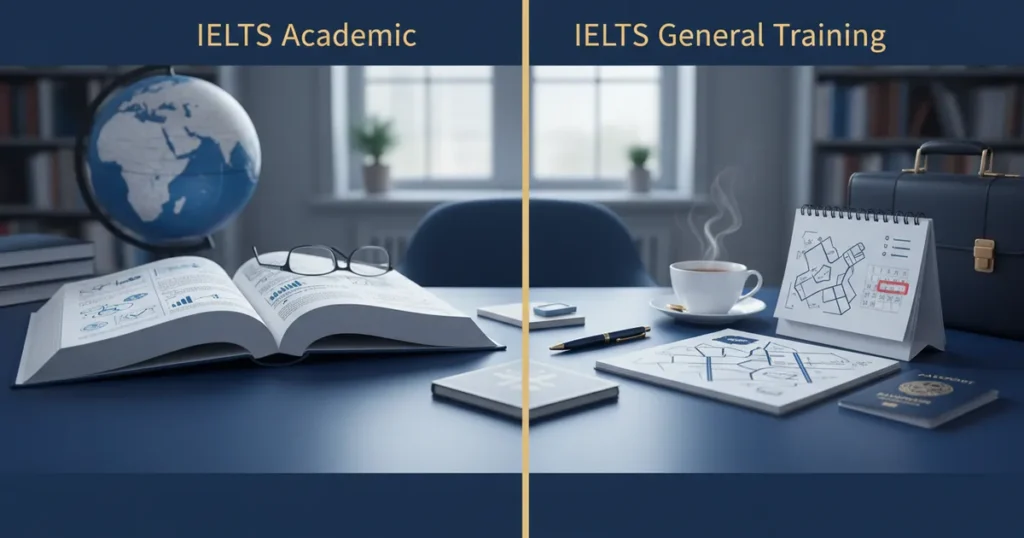
One of the most common mistakes beginners make is preparing for the wrong module. The Academic test is for those applying for higher education or professional registration (like doctors or nurses). It features complex texts and data analysis. The General Training test is for migration and secondary education, focusing on survival skills in broad social and workplace contexts. Many students find success by preparing for IELTS at home using structured digital resources tailored to their specific module.
The Four Pillars of the Exam
Every beginner must understand that IELTS is a test of proficiency, not just memory. You cannot “cram” for IELTS. You must develop skills in four distinct areas:
- Listening (30-40 minutes): Understanding various English accents and extracting specific information from conversations and lectures.
- Reading (60 minutes): Managing time while answering 40 questions based on three long passages.
- Writing (60 minutes): Producing two distinct pieces of writing (a report/letter and an essay) with grammatical precision and logical flow.
- Speaking (11-14 minutes): A face-to-face or video-call interview with an examiner to test your fluency and coherence.
What Examiners and Test Centres Say for 2026
Examiners in 2026 are placing a higher premium on “naturalness” and “lexical flexibility.” This means that memorized templates and “big words” used incorrectly will actually lower your score. Test centers, including the British Council, emphasize that the test is designed to reflect how you will use English in the real world.
“The biggest hurdle for beginners in 2026 isn’t the difficulty of the English language itself, but the ability to perform under the specific constraints of the test format. Consistency in practice is far more valuable than intensity.”
Senior IELTS Examiner, 2025 Symposium
The marking criteria (Band Descriptors) remain the most important document for any beginner. You should study these descriptors for Writing and Speaking to understand exactly what is required for a Band 7 or 8. For instance, in Speaking, “Fluency and Coherence” accounts for 25% of your score. For those focusing on the verbal component, consistent speaking practice at home is vital for building fluency and reducing the “hesitation” that often traps beginners.
Scoring and Conversion: A Beginner’s Guide
Understanding how your raw marks (the number of correct answers) translate into a Band Score is essential for setting realistic goals. Below is a simplified conversion table for the Listening and Reading modules.
| Raw Score (out of 40) | IELTS Band Score | Proficiency Level |
|---|---|---|
| 39-40 | 9.0 | Expert User |
| 35-36 | 8.0 | Very Good User |
| 30-32 | 7.0 | Good User |
| 23-26 | 6.0 | Competent User |
| 16-19 | 5.0 | Modest User |
| 10-12 | 4.0 | Limited User |
Key Tips and Practical Advice: ielts for beginners 2026: where to start your preparation journey
Now that you understand the structure, how do you actually begin? Here is a curated list of actionable steps for any beginner starting their journey in 2026:
- Audit Your Current Level: Don’t guess your level. Take a timed practice test. If you score a 5.0 and need a 7.5, you know you need at least 6 months of intensive work.
- Master the Question Types: IELTS has over 15 different question types in Reading alone (True/False/Not Given, Matching Headings, etc.). You need a specific strategy for each one. Utilizing IELTS Reading practice tests allows you to get used to the time pressure and these various formats.
- Build Vocabulary Contextually: Instead of memorizing word lists, read articles from the BBC, The Economist, or National Geographic. Note how words are used in sentences.
- Focus on Task Response: In Writing, many beginners fail because they don’t answer all parts of the question. Reviewing common IELTS Writing Task 2 topics can help you develop a bank of ideas and ensure you stay on topic.
- Immerse Yourself: Change your phone settings to English, watch movies without subtitles, and listen to English podcasts during your commute.
- Use Official Materials: Avoid unofficial “leaked” questions. Stick to Cambridge IELTS books and verified platforms. Consider enrolling in a free IELTS online course to get a comprehensive overview of the curriculum.
Common Myths Debunked
As you begin your ielts for beginners 2026: where to start your preparation journey, you will likely encounter misinformation. Let’s clear the air:
Myth 1: “The Computer-Delivered Test is harder than the paper one.”
The content, scoring, and difficulty level are identical. The only difference is the medium. Many find the computer test easier because of the word counter in Writing and the ability to use headphones in Listening.
Myth 2: “You need a British or American accent to score high in Speaking.”
This is false. The examiner is looking for clarity and pronunciation, not an accent. As long as you are easy to understand, your native accent will not prevent you from getting a Band 9.
Myth 3: “If I write more than the word limit, I’ll get a higher score.”
Quality over quantity. Writing 400 words for a 250-word essay often leads to more grammatical errors and a loss of focus. Aim for 260-280 words to be safe.
What to Do: Before, During, and After Your Prep
Before You Start (The Foundation Phase)
Before you even open a practice book, ensure your general English level is sufficient. If you are an absolute beginner in English (A1/A2 level), you should focus on general grammar and vocabulary for 3 months before starting IELTS-specific training. IELTS is a test of English, not just a test of “tricks.”
During Your Prep (The Skill-Building Phase)
Divide your study into “Skill Days” and “Test Days.” On Skill Days, focus on one module (e.g., Reading) and learn techniques like skimming and scanning. On Test Days, take a full, timed section to build stamina. Use resources like IELTS Reading tips to refine your approach.
After Preparation (The Mock Phase)
In the two weeks before your exam, take at least three full-length mock tests under exam conditions. This means no phone, no water breaks (unless allowed), and strict timing. This reduces anxiety on the actual test day.
Frequently Asked Questions (FAQs)
How long does it take to prepare for IELTS as a beginner?
For most students with an intermediate level of English, 8 to 12 weeks of consistent study (1-2 hours a day) is usually sufficient to see a significant band score improvement.
Can I take the IELTS exam online from home in 2026?
Yes, the “IELTS Online” version is available in many countries for the Academic module. However, always check if your target institution (university or immigration office) accepts the online version, as some still require the in-center test.
What is the most difficult part of IELTS for beginners?
Statistically, Writing Task 2 is the most challenging for beginners due to the requirement for complex sentence structures and logical argumentation under a strict time limit.
Official Links and Verified Information
To ensure you are getting the most accurate information for 2026, always refer to these official sources:
- The British Council: Official Booking and Practice Materials
- IDP IELTS: The other official partner for IELTS testing globally.
- Cambridge University Press: The official publishers of the IELTS practice books.
Related Topics Worth Reading
To further enhance your ielts for beginners 2026: where to start your preparation journey, consider exploring these specialized guides:
- Grammar for IELTS: Focus on complex sentences and punctuation.
- IELTS Listening Accents: How to understand Australian, British, and Canadian speakers.
- Time Management Strategies: How to never run out of time in the Reading module.
- IELTS for Canada PR: Specific requirements for the Express Entry system in 2026.
Summary and Action Checklist
Your journey to a high IELTS score in 2026 is a marathon, not a sprint. By starting with the right mindset and the right resources, you eliminate the frustration that many beginners face. Here is your final checklist to get started today:
- [ ] Identify your module (Academic vs. General Training).
- [ ] Take a 3-hour diagnostic practice test.
- [ ] Set a target band score based on your university or visa requirements.
- [ ] Create a study schedule (minimum 5 hours per week).
- [ ] Bookmark SimplyIELTS.com for daily tips and free resources.
- [ ] Register for your test date at least 2 months in advance to secure your spot.
The road to 2026 is paved with opportunity. By mastering the IELTS, you are opening doors to global possibilities. Don’t wait for the “perfect” time to start—the best time is now. Dive into our free IELTS online course and let’s get you that Band 8.0!
Related Resources
- Most Repeated IELTS Speaking Cue Cards of All Time: Essential Preparation List
- IELTS Preparation for Working Professionals: Study Tips with Limited Time
- IELTS Reading Common Mistakes Beginners Make and How to Fix Them 2026
- Describe a Long Journey You Went On — IELTS Speaking Cue Card (Band 9 Sample Answer)
- IELTS 3-Month Study Plan: Complete Preparation Schedule 2026
- Describe a Difficult Journey you Have Had — IELTS Speaking Cue Card (Band 9 Sample Answer)
- IELTS Tips
- IELTS Band Score Calculator




Responses