
How to Prepare for IELTS at Home: Complete Self-Study Guide 2026

Achieving a high band score in the IELTS exam is a dream for thousands of students and professionals worldwide. Whether you are aiming for a master’s degree in London or seeking a work permit in Kuala Lumpur, the International English Language Testing System is your gateway to global opportunities. However, the common misconception is that you need expensive coaching centers to succeed. In reality, learning how to prepare for IELTS at home is not only possible but often more effective because it allows you to tailor your study schedule to your specific strengths and weaknesses.
In this comprehensive guide, we will walk you through every step of the journey. From understanding the test format to mastering the nuances of the Speaking and Writing modules, we provide a roadmap that has helped countless students achieve Band 7.5 and above. By utilizing resources like our Complete Guide to the IELTS Test, you can transform your living room into a high-performance classroom. Let’s dive into the strategies that will help you conquer the exam without ever leaving your house.
Success in IELTS is 20% English proficiency and 80% strategy and familiarity with the test format. If you are wondering how to prepare for IELTS at home, the answer lies in consistency, high-quality materials, and a structured plan. Whether you have months or just a few weeks, this guide will provide the tools you need to excel in the Academic or General Training modules.
Can You Prepare for IELTS Alone?
The short answer is: Absolutely. Many candidates find that self-study offers a level of focus that a crowded classroom cannot provide. When you study alone, you can spend two hours on your weakest area—perhaps the “True, False, Not Given” questions in Reading—rather than following a generic curriculum designed for thirty different people. However, self-study requires a high degree of discipline and the right roadmap.
One of the biggest hurdles when learning how to prepare for IELTS at home is the lack of immediate feedback, especially for Speaking and Writing. To overcome this, you must become your own examiner. You need to understand the marking criteria as deeply as the examiners do. By reviewing official samples and using our IELTS Tips, you can learn to spot your own grammatical errors and improve your coherence and cohesion.
Preparation is the bridge between your current English level and your target band score. When you study at home, you aren’t just learning a language; you are learning the art of the exam.
Senior IELTS Instructor, SimplyIELTS.com
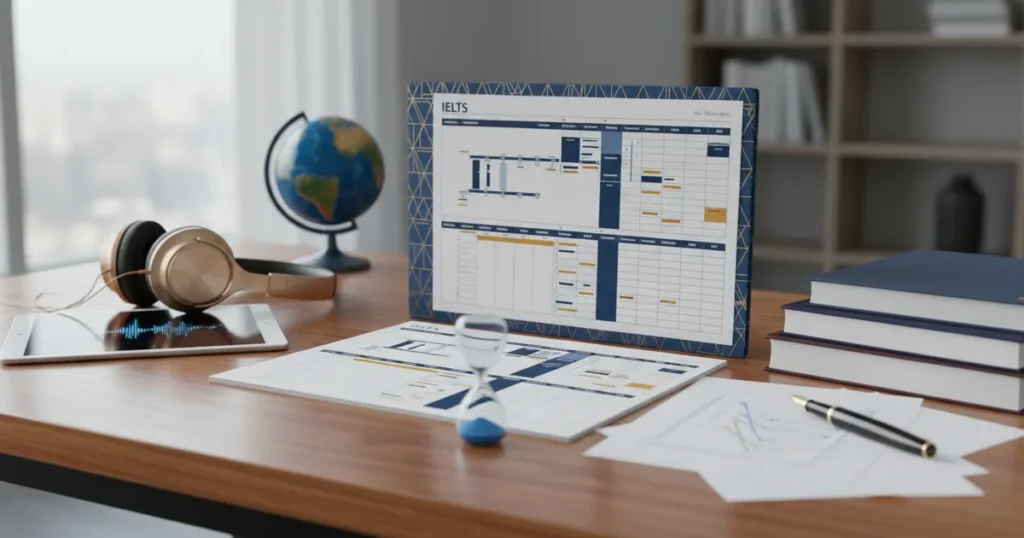
Creating Your 30-Day Study Plan for Self-Learners
A month is an ideal timeframe for most candidates to polish their skills. If you are in a rush, you might consider an IELTS 7-Day Study Plan: How to Prepare for IELTS in One Week, but for a deep dive, a 30-day approach is superior. Here is how you should structure your month:
Week 1: Foundations and Familiarization
Your first week should be dedicated to understanding the test format. Visit the IELTS Official Website to download the latest information for candidates. You need to know exactly how long the IELTS test lasts and what each section entails. Take a full-length diagnostic test to identify your baseline score. Don’t worry if it’s low; this is just your starting point.
Week 2: Passive and Active Skills
Focus on Listening and Reading. These are the “input” skills where you can score the highest marks. Practice with diverse materials. For example, work on map labeling by practicing the Plan of Stevenson’s Site — Listening task. For Reading, focus on academic texts like Plant Thermometer Triggers Growth to build your vocabulary and speed.
Week 3: The Output Skills (Writing and Speaking)
This is often the hardest part of how to prepare for IELTS at home. For Writing Task 2, you must master the art of brainstorming. We recommend learning how to plan an essay in 5 minutes to ensure you never run out of time. For Speaking, record yourself answering common questions and play them back to check for fluency and pronunciation.
Week 4: Mock Tests and Refinement
In the final week, simulate exam conditions. Sit in a quiet room, set a timer, and do not take breaks. If you are feeling overwhelmed, you can simplify your final push with a 1-Week IELTS Study Plan: Intensive Preparation Guide to focus only on the most high-impact strategies.
How to Prepare for IELTS at Home: Essential Steps
To succeed without a tutor, you need to set up your environment and resources correctly. Here are the actionable steps you should take today:
- Analyze the Band Descriptors: Download the public version of the marking criteria for Writing and Speaking from the British Council IELTS site.
- Build an English Immersion Environment: Change your phone language to English, watch BBC or CNN, and listen to English podcasts daily.
- Master Time Management: The Reading test gives you 60 minutes for 40 questions. Practice spending no more than 15-17 minutes on the first passage.
- Expand Your Vocabulary: Don’t just learn words; learn collocations (words that naturally go together).
- Use Official Practice Materials: Stick to Cambridge IELTS books or reputable sites like SimplyIELTS to avoid outdated or inaccurate practice questions.
- Understand Local Requirements: If you are applying for a specific region, check the IELTS for Malaysia: Study and Work Visa Requirements Guide 2026 to know your target score.
Daily Study Routine (2 Hours)
Consistency is more important than intensity. Studying for 2 hours every day is better than a 10-hour marathon once a week. Here is a sample daily breakdown for someone learning how to prepare for IELTS at home:
| Time Slot | Module | Activity |
|---|---|---|
| 00:00 – 00:30 | Listening | Complete one full practice section and review mistakes. |
| 00:30 – 01:00 | Reading | Read one long article and summarize it in 3 sentences. |
| 01:00 – 01:45 | Writing | Write a Task 1 report or a Task 2 essay outline. |
| 01:45 – 02:00 | Speaking | Speak aloud for 15 minutes about a random topic. |
Module-Specific Strategies for Home Study
IELTS Listening: The Art of Multi-tasking
When you are at home, use headphones to practice. In the actual test (especially the computer-delivered version), you will have headphones. Practice “active listening”—don’t just listen for the answer; try to understand the context. Common traps include speakers correcting themselves (e.g., “We will meet at 6 PM… oh wait, no, let’s make it 7 PM”). If you need a structured approach, follow our IELTS Exam Preparation: Study Plan for 7 Days which focuses heavily on these nuances.
IELTS Reading: Speed vs. Accuracy
The secret to Reading is not reading every word. You must master skimming (reading for the general idea) and scanning (looking for specific keywords). When studying how to prepare for IELTS at home, use a timer for every passage. If you find yourself stuck on a question for more than 90 seconds, move on. You can always come back later.
IELTS Writing: Structure is King
Writing is the module where most students get stuck at Band 6.0 or 6.5. This is usually due to poor paragraphing or lack of task response. For Task 2, ensure your introduction clearly states your opinion. Use a four-paragraph structure: Intro, Body 1, Body 2, and Conclusion. By using the techniques in our guide on essay planning, you ensure your ideas flow logically.
IELTS Speaking: Building Confidence
Many students feel shy practicing Speaking alone. However, this is the best time to experiment with new vocabulary. Start with easy topics. For instance, practice Talking About Your Hometown. Focus on using “fillers” naturally (e.g., “That’s an interesting question…”) to give yourself time to think without pausing awkwardly.
How to Practice Speaking Without a Partner
One of the most frequent questions we get about how to prepare for IELTS at home is: “Who will I talk to?” You don’t necessarily need a partner to improve. Here are three techniques:
1. The Mirror Technique
Talk to yourself in the mirror. This helps you monitor your body language and facial expressions, which can impact your confidence and intonation. Pay attention to how your mouth moves when pronouncing difficult sounds like “th” or “r”.
2. Recording and Transcribing
Record yourself answering a Part 2 cue card (2 minutes). Then, listen to it and write down exactly what you said. You will be shocked at how many “ums,” “ahs,” and small grammatical errors you catch. Correct the transcript and read it aloud again.
3. Shadowing
Find a video of a Band 9.0 candidate or a native speaker. Listen to a sentence and repeat it immediately after them, mimicking their speed, rhythm, and emotion. This is the fastest way to improve your pronunciation and prosody.
Tracking Your Progress
You cannot improve what you do not measure. Keep a “Mistake Journal.” Every time you get a Reading or Listening question wrong, don’t just look at the correct answer. Write down why you got it wrong. Was it a spelling error? Did you misunderstand a synonym? Did you miss a “distractor”?
As you learn how to prepare for IELTS at home, use this conversion table to estimate your current band score based on your practice tests:
| Correct Answers (out of 40) | Reading (Academic) Band | Listening Band |
|---|---|---|
| 39-40 | 9.0 | 9.0 |
| 35-36 | 8.0 | 8.0 |
| 30-32 | 7.0 | 7.0 |
| 23-26 | 6.0 | 6.0 |
| 15-18 | 5.0 | 5.0 |
Best Free Resources for Each Module
The internet is full of resources, but quality varies. To effectively learn how to prepare for IELTS at home, stick to these trusted sources:
- Vocabulary: Read editorials from The Guardian or The Economist.
- Listening: TED Talks and the “6 Minute English” podcast by the BBC.
- Practice Tests: The official practice papers on the British Council website.
- Strategy: The SimplyIELTS blog and our Comprehensive Course.
When to Take the Test
Don’t rush to book your test the moment you start studying. You should book your IELTS exam only when you are consistently hitting 0.5 bands higher than your target in your practice tests. For example, if you need a Band 7.0, you should be scoring 7.5 in your home mock exams. This provides a “buffer” for the nerves and pressure of the actual test day.
Remember, the test fee is significant. It is better to spend an extra two weeks mastering how to prepare for IELTS at home than to pay for the exam twice. If you feel ready but want a final boost, our 1-week preparation guide is the perfect final touch.
Conclusion: Your Path to Band 8.0 Starts Today
Learning how to prepare for IELTS at home is a rewarding challenge. It forces you to take ownership of your learning, a skill that will serve you well when you eventually move abroad for study or work. By following a structured 30-day plan, utilizing high-quality resources like the Plant Thermometer Reading practice, and staying consistent with your daily routine, the band score you desire is well within reach.
Don’t let the exam intimidate you. With the right strategies, such as mastering Writing Task 2 planning and practicing your speaking through shadowing, you can walk into the test center with total confidence. Ready to take the next step? Explore our Complete Guide to the IELTS Test and start your journey toward a brighter future today!


Responses