
Difference Between Academic and General Training IELTS Questions 2026: Examples


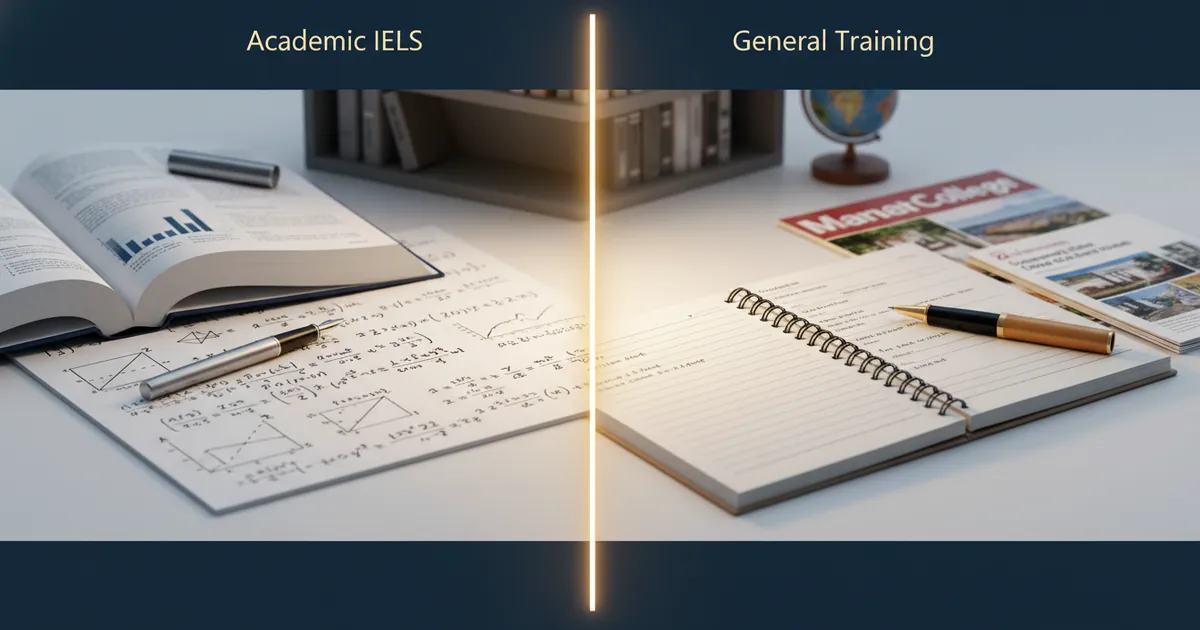
Choosing between the Academic and General Training modules is the first major decision any IELTS candidate faces. As we move into the current testing cycle, understanding the specific difference between academic and general training ielts questions 2026: examples is crucial for achieving your target band score. While both versions of the test share identical Listening and Speaking components, the Reading and Writing sections are tailored to different goals—higher education for Academic and migration or secondary education for General Training. In this comprehensive guide, we will dissect the latest trends, provide real-world examples from recent exams, and offer model answers to help you navigate these differences with confidence.
Whether you are planning to study at a top-tier university or seeking to build a new life in an English-speaking country, your preparation must be surgical. You cannot simply use generic materials and expect a Band 8 or 9. By analyzing the difference between academic and general training ielts questions 2026: examples, you can tailor your vocabulary, tone, and structural approach to meet the specific expectations of the examiners. This article serves as your roadmap to mastering these nuances, featuring confirmed questions reported by candidates in the first quarter of 2026.
Overview: IELTS Exam Trends for the 2026 Period
The year 2026 has seen a subtle shift in how the International English Language Testing System (IELTS) assesses candidates. While the core criteria remain the same, there is an increased emphasis on “digital literacy” themes in the Academic module and “workplace adaptability” in the General Training module. For those just starting their journey, our IELTS exam preparation guide provides a foundational look at these evolving requirements.
One notable trend is the integration of more complex data sets in Academic Writing Task 1, often requiring candidates to synthesize information from two different types of charts (e.g., a bar chart and a table). Conversely, General Training Task 1 letters have become more nuanced, frequently requiring a “semi-formal” tone that sits between strictly professional and strictly personal. Understanding these shifts is the key to identifying the difference between academic and general training ielts questions 2026: examples that will appear on your test day.
Core Comparison: Difference Between Academic and General Training IELTS Questions 2026: Examples
To provide a clear visual of how these tests diverge, the following table outlines the structural and thematic variations you will encounter. This is the first step in recognizing why your study strategy must differ based on the module you choose.
| Section | Academic Module Focus | General Training Module Focus |
|---|---|---|
| Reading | Three long, complex texts from journals, books, and magazines. Academic/Scientific tone. | Five to six shorter texts from flyers, advertisements, and workplace handbooks. Social/Workplace tone. |
| Writing Task 1 | Data description (Charts, Graphs, Tables, Diagrams, Maps). Objective and formal. | Letter writing (Formal, Semi-formal, or Personal). Tone varies by prompt. |
| Writing Task 2 | Formal essay on academic topics (e.g., technology, environment, sociology). | Semi-formal essay on general interest topics (e.g., family, community, hobbies). |
| Speaking | Identical for both. Focus on personal experience and abstract discussion. | Identical for both. Focus on personal experience and abstract discussion. |
Confirmed Questions That Appeared (Reported by Candidates)
Staying updated with recent exam questions is one of the most effective ways to prepare. Here are three confirmed questions from early 2026 that highlight the difference between academic and general training ielts questions 2026: examples.
Question 1: Academic Writing Task 1 (Data Interpretation)
“The bar chart below shows the percentage of renewable energy consumption in four different countries between 2015 and 2025. Summarize the information by selecting and reporting the main features, and make comparisons where relevant.”
Question 2: General Training Writing Task 1 (Letter Writing)
“You recently stayed at a hotel and left an important personal item behind. Write a letter to the hotel manager. In your letter: explain when you stayed there, describe the item you lost, and suggest how the hotel can return it to you.”
Question 3: Writing Task 2 (Common Theme – Education)
“Some people believe that it is more important for universities to provide students with practical skills for the workplace rather than theoretical knowledge. To what extent do you agree or disagree?” (Note: While this topic appears in both, the Academic version often expects more formal evidence, while the GT version allows for more personal anecdotes).
Band 9 Model Answer for Question 1 (Academic Task 1)
For those pursuing the Academic route, our IELTS Writing Task 1 Academic course offers deep dives into these types of questions. Below is a model answer for the renewable energy bar chart.
The bar chart illustrates the proportions of renewable energy utilized in four distinct nations over a decade-long period from 2015 to 2025. Overall, it is evident that while all countries experienced an upward trend in renewable energy consumption, the rate of growth varied significantly, with Country A emerging as the leader by the end of the period.
In 2015, Country B held the highest share of renewable energy at approximately 25%, followed closely by Country A at 20%. Over the subsequent ten years, Country A witnessed a dramatic surge, nearly doubling its consumption to reach a peak of 38% by 2025. In contrast, Country B’s growth was more modest, plateauing at 30% in the final year.
Countries C and D started at much lower baselines, with 10% and 5% respectively. While Country C showed a steady inclination to reach 18% by 2025, Country D remained the lowest consumer throughout the period, despite a three-fold increase to 15%. Ultimately, the data highlights a global shift toward sustainable energy sources, albeit at different velocities across the surveyed nations.
Vocabulary Analysis for Academic Task 1
- Proportions: A more sophisticated synonym for “percentages.”
- Upward trend: Essential for describing direction in data.
- Surge: Indicates a rapid increase.
- Plateauing: Describes a period where figures remain steady after a rise.
- Inclination: Used here to describe a steady upward slope.
Band 9 Model Answer for Question 2 (General Training Task 1)
General Training candidates must master the art of tone. Our IELTS Writing Task 1 General Training course focuses on the stylistic differences between formal and informal letters. Here is a response to the hotel manager prompt.
Dear Sir or Madam,
I am writing to formally request your assistance in locating a personal item that I inadvertently left in my room during my recent stay at your establishment. My name is John Doe, and I was a guest in Room 402 from the 12th to the 15th of January, 2026.
The item in question is a black leather laptop sleeve containing a silver MacBook Pro. I believe it was left on the bedside table or perhaps tucked slightly under the bed. This device contains critical work documents that are essential for my upcoming projects, making its recovery a matter of great urgency.
If the item has been found by your housekeeping staff, I would be most grateful if you could arrange for its return. I am happy to cover all courier expenses. Alternatively, a friend of mine resides in the city and could collect it on my behalf tomorrow afternoon. Please let me know which option is more convenient for you.
Thank you for your prompt attention to this matter. I look forward to hearing from you soon.
Yours faithfully,
John Doe
Vocabulary Analysis for General Training Task 1
- Inadvertently: A high-level way to say “by accident.”
- Establishment: A formal synonym for “hotel.”
- Item in question: A professional phrase to introduce the subject.
- Matter of great urgency: Emphasizes importance without sounding aggressive.
- On my behalf: Indicates someone else acting for you.
Band 9 Model Answer for Question 3 (Writing Task 2)
Task 2 is where both modules converge, yet the difference between academic and general training ielts questions 2026: examples often lies in the nature of the prompt. Academic prompts lean toward the abstract, while GT prompts lean toward the societal. For more practice, check out our IELTS Writing Task 2 topics repository.
The debate over whether higher education should prioritize vocational skills or theoretical knowledge is more relevant than ever in the modern economy. While some argue that universities should be centers of pure academic inquiry, I believe that a pragmatic approach focusing on practical skills is essential for student success in the contemporary job market.
Proponents of theoretical education argue that the primary role of a university is to cultivate critical thinking and a deep understanding of fundamental principles. They suggest that if students only learn specific technical skills, they may find their knowledge obsolete as technology evolves. For instance, a computer science student who understands the underlying logic of algorithms can adapt to any new programming language, whereas one trained only in a specific software might struggle. Thus, theory provides the foundation for lifelong learning.
However, the escalating cost of tuition and the competitive nature of the global workforce necessitate a shift toward practicality. Many graduates find themselves “over-educated but under-skilled,” possessing vast amounts of knowledge but unable to perform basic professional tasks. By integrating internships and hands-on projects into the curriculum, universities can ensure that students are “job-ready” upon graduation. This not only benefits the individual but also reduces the training burden on employers, fostering a more efficient economy.
In conclusion, while theoretical knowledge remains the bedrock of intellectual development, it must be balanced with practical application. I believe universities should adopt a hybrid model that equips students with both the “why” and the “how,” ensuring they are intellectually robust and professionally capable.
Vocabulary Analysis for Writing Task 2
- Pragmatic approach: A practical way of dealing with things.
- Obsolete: No longer produced or used; out of date.
- Escalating cost: Rapidly increasing prices.
- Job-ready: Possessing the skills needed to start work immediately.
- Intellectually robust: Strong and healthy in terms of mental ability.
Expert Perspective on the 2026 IELTS Landscape
“The real difference between the two modules isn’t just the difficulty of the text; it’s the intent of the communication. Academic candidates are being tested on their ability to handle complex information, while General Training candidates are tested on their ability to survive and thrive in an English-speaking society. Success in 2026 requires understanding this ‘functional’ difference.”
Senior IELTS Examiner, SimplyIELTS.com
Key Vocabulary and Phrases for the Topics That Appeared
To excel in both modules, you need a versatile vocabulary. Here are some clusters based on the 2026 trends we’ve observed in the difference between academic and general training ielts questions 2026: examples.
Academic-Specific Lexis (Data & Science)
- Correlate: To have a mutual relationship or connection.
- Discrepancy: A lack of compatibility or similarity between two or more facts.
- Exponentially: (With reference to an increase) more and more rapidly.
- Empirical evidence: Information acquired by observation or experimentation.
- Synthesize: To combine various components into a connected whole.
General Training-Specific Lexis (Social & Workplace)
- Grievance: A real or imagined cause for complaint, especially unfair treatment.
- Commence: A formal way to say “begin” or “start.”
- Mutual benefit: Something that is advantageous to both parties involved.
- Promptly: With little or no delay; immediately.
- Acquaintance: A person one knows slightly, but who is not a close friend.
Patterns: Recurring Themes the Examiner Keeps Returning To
By studying the difference between academic and general training ielts questions 2026: examples, we can identify “evergreen” themes. For the Academic module, these include climate change, urbanization, and advancements in biotechnology. Examiners love these because they provide ample opportunity for complex sentence structures and high-level vocabulary. If you are struggling with the Reading aspect of these themes, our IELTS reading tips and tricks can help you decode dense academic prose.
For General Training, the themes are more grounded. Expect questions about remote work culture, community volunteering, and the impact of social media on family dynamics. The key here is not just knowing the topic, but being able to discuss it in a way that feels natural yet sophisticated. For the Speaking section, which remains the same for both, practicing with current IELTS speaking part 2 topics is essential for building fluency.
How to Use These Real Questions in Your Study Plan
Don’t just read these questions—active practice is the only way to improve. Here is a 5-step action plan to integrate these examples into your routine:
- Timed Practice: Set a timer for 20 minutes for Task 1 and 40 minutes for Task 2. Use the questions provided above to simulate exam conditions.
- Comparative Analysis: Write a response for an Academic Task 1 and then a GT Task 1. Notice how your tone shifts from objective data reporting to subjective correspondence.
- Vocabulary Mapping: For every model answer you read, extract 5 new words and use them in three original sentences.
- Peer Review: Join a study group or use an online platform to get feedback. Understanding how others interpret the difference between academic and general training ielts questions 2026: examples can broaden your perspective.
- Official Benchmarking: Periodically check the IELTS Official Website for any updates to the test format or marking criteria to ensure your practice remains relevant.
Predicted Topics for the Next Test Window
Based on our analysis of current global events and previous test patterns, we predict the following topics will feature heavily in the coming months:
- Academic: The ethics of Artificial Intelligence in research; the impact of microplastics on marine ecosystems; the history of urban architecture.
- General Training: Balancing work and life in a “gig economy”; the importance of local libraries in the digital age; writing a letter to a neighbor about a shared fence or garden issue.
- Common Task 2: Whether the government should subsidize public transport to reduce carbon emissions (Agree/Disagree).
Actionable Tips for Success in 2026
To truly master the difference between academic and general training ielts questions 2026: examples, keep these tips in mind:
- Focus on the Task Response: In GT Task 1, ensure you cover all three bullet points in the letter, or you will be penalized.
- Vary Your Sentences: Use a mix of simple, compound, and complex sentences. This is a requirement for Band 7 and above.
- Check Your Spelling: In 2026, examiners are strictly enforcing spelling accuracy, especially in the Reading and Listening modules.
- Don’t Memorize: Use model answers to learn structures and vocabulary, but never memorize whole paragraphs. Examiners are trained to spot “canned” responses.
- Use Practical Resources: Take advantage of our IELTS quizzes to test your knowledge of grammar and vocabulary in short, manageable bursts.
- Understand the Marking Rubric: Familiarize yourself with the public version of the band descriptors for Writing and Speaking.
Resources: Full Practice Tests and Model Answer Bank
Preparation is a marathon, not a sprint. To help you cross the finish line, we have curated a selection of resources specifically designed for the 2026 exam cycle. If you are struggling with the essay portion, our IELTS Writing Task 2 course is an invaluable asset. It breaks down every essay type—from “Discussion” to “Problem/Solution”—with step-by-step guidance.
Additionally, for those who need to see the difference between academic and general training ielts questions 2026: examples in a full-length format, we recommend taking multiple practice tests under timed conditions. This builds the mental stamina required for the three-hour exam. Remember, the difference between a Band 6.5 and a Band 7.5 often comes down to the small details: a well-placed semi-colon, a more precise adjective, or a clearer logical progression.
Conclusion
Understanding the difference between academic and general training ielts questions 2026: examples is the foundation of a successful study plan. While the Academic module demands a high level of analytical skill and formal language, the General Training module requires a versatile range of tones and a focus on practical communication. By studying the model answers and vocabulary provided in this guide, you are already ahead of the curve.
Are you ready to take the next step? Whether you need to master the data descriptions of the Academic test or the letter-writing nuances of the General Training test, SimplyIELTS.com is here to support you. Explore our full range of courses, take a free practice quiz, and start your journey toward your dream band score today. Your future is waiting—let’s make sure your English skills are ready to meet it!





Responses