
Describe an Important Text Message you Received — IELTS Speaking Cue Card (Band 9 Sample Answer)


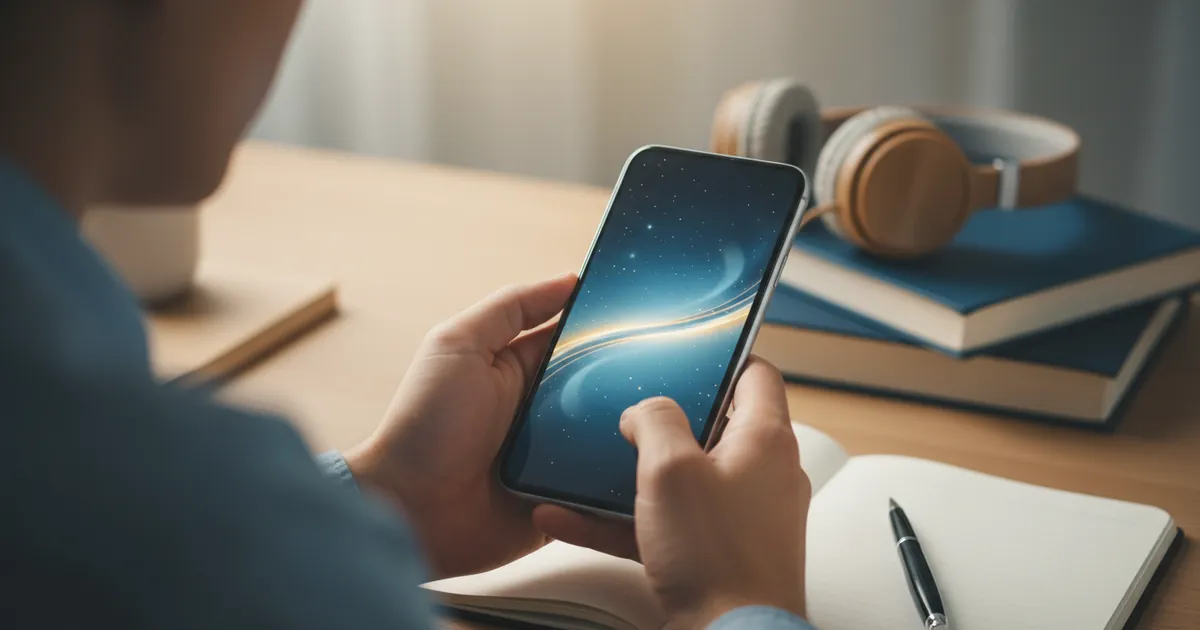
If you are preparing for your IELTS exam, you may be asked to describe an important text message you received during the Speaking Part 2 section. This prompt has become increasingly common in recent exams, such as those listed in our guide to IELTS Speaking topics January to April 2026, and requires you to speak about a digital interaction that had a significant impact on your life. In this post, we provide a Band 9 model answer, a simplified Band 7 version, and a deep dive into the vocabulary and grammar needed to excel.
The Cue Card
Describe an important text message you received.
You should say:
• When and where you received it
• Who sent it to you
• What the message was about
And explain why this message was so important or memorable to you.
Band 9 Sample Answer
I’d like to talk about a text message that quite literally changed the course of my career and life, which I received about two years ago. At the time, I was sitting in a rather drab, windowless library at my university, struggling to focus on my final dissertation. I remember my phone was face down on the mahogany desk because I was trying to avoid any digital distractions. Suddenly, the phone vibrated with a distinctive “ping,” and although I tried to ignore it, curiosity got the better of me. The message was from a senior recruiter at a multinational firm where I had interviewed for a highly competitive internship several weeks prior. I had almost given up hope, thinking I’d been passed over for the role. The text was brief but impactful; it read, “Hi, we’d love to offer you the position. Please check your email for the formal offer letter.” My heart skipped a beat, and I felt a massive surge of adrenaline. It was a pivotal moment because that internship was my “foot in the door” for the industry I had dreamed of joining since childhood. If I hadn’t received that specific notification at that exact moment, I might have accepted a much less fulfilling role elsewhere. The significance lay not just in the job itself, but in the validation it provided after months of grueling applications and rejections. It was a moment of pure, unadulterated joy that turned a mundane afternoon of studying into a milestone I will never forget. I remember staring at the screen for what felt like an eternity, just letting the news sink in before I finally breathed a sigh of relief and called my parents to share the news.
Band 7 Sample Answer
I want to tell you about an important text message I got last year. I was at home, just having dinner with my family, when my phone buzzed on the table. It was a message from my best friend, who lives in another city. She sent me a text to tell me that she had finally passed her driving test after failing it three times before. The message was very simple; it just said, “I did it! I’m a licensed driver now!” accompanied by a lot of happy emojis. This was very important to me because I knew how much she had struggled with her confidence after her previous failures. I felt really happy for her because she had worked so hard and practiced every weekend for months. It was memorable because we had a plan to go on a road trip together during the summer, but we couldn’t do it unless she had her license. Receiving that text meant that our dream holiday was finally going to happen. I immediately replied to congratulate her and we started planning our trip that same night. It showed me that persistence really pays off, and I was glad she shared her success with me first.
How the Band 9 Answer Scores Top Marks
Fluency and Coherence
The Band 9 answer flows naturally, using sophisticated cohesive devices to link ideas. Instead of just saying “Then I did this,” the speaker uses phrases like “curiosity got the better of me” and “letting the news sink in” to create a narrative arc. The story moves logically from the setting (the library) to the climax (the message) and finally to the emotional impact. This level of coherence is much higher than simply answering the bullet points in order. For more on maintaining flow, check out our IELTS Speaking tips.
Lexical Resource
The speaker uses a wide range of topic-specific and idiomatic vocabulary. Phrases like “quite literally changed the course of my career,” “drab, windowless library,” and “massive surge of adrenaline” demonstrate a high level of precision. The use of the idiom “foot in the door” is particularly effective as it is used correctly in context. Using varied adjectives like “mundane” and “grueling” rather than simple words like “boring” or “hard” helps push the score toward a Band 9.
Grammatical Range and Accuracy
The sample answer showcases complex grammatical structures effortlessly. For instance, the use of a third conditional—“If I hadn’t received that specific notification… I might have accepted…”—is a hallmark of advanced English proficiency. The speaker also uses relative clauses (“where I had interviewed…”) and past perfect tense (“thinking I’d been passed over”) to clarify the timeline of events. Accuracy is maintained throughout, even with these complex forms.
Pronunciation
While the text cannot demonstrate audio, a Band 9 performance would involve natural intonation and stress. For example, emphasizing the word “literally” or “massive” adds emotional weight to the story. The speaker would avoid a robotic tone by using contractions like “I’d” and “didn’t,” which are standard in spoken English. For more on this, see our lesson on IELTS Speaking behaviour and politeness.
Vocabulary and Idioms to Use
| Word/Phrase | Meaning | Example Sentence |
|---|---|---|
| Out of the blue | Completely unexpected. | The message came out of the blue while I was at work. |
| Pivotal | Of crucial importance in relation to the development of something. | Receiving that text was a pivotal moment in my life. |
| On tenterhooks | In a state of uneasy suspense. | I had been on tenterhooks all week waiting for the exam results. |
| Over the moon | Extremely happy and excited. | When I read the news, I was absolutely over the moon. |
| To ping | The sound a phone makes when a message arrives. | I heard my phone ping on the bedside table. |
| Breathe a sigh of relief | To feel better after a period of worry. | I breathed a sigh of relief when I realized I hadn’t missed the deadline. |
| Life-altering | Having a significant effect on a person’s life. | It was a life-altering message that changed my future. |
| To sink in | To be fully understood or realized. | It took a few minutes for the importance of the text to sink in. |
| Notification | An automated alert on a digital device. | I saw a notification pop up on my lock screen. |
| Mundane | Lacking interest or excitement; dull. | The message turned a mundane day into an extraordinary one. |
Grammar Structures That Boost Your Band Score
- Third Conditional for Regret or Alternative Outcomes: “If I hadn’t checked my phone at that moment, I would have missed the opportunity.”
- Past Perfect for Background Information: “I had been waiting for that specific text for nearly a fortnight.”
- Cleft Sentences for Emphasis: “It was only when I read the message for the third time that I truly believed it.”
- Relative Clauses to Add Detail: “The person who sent the message, my former professor, has always been a mentor to me.”
- Participle Phrases: “Having read the text, I immediately burst into tears of joy.”
- Inversion for Dramatic Effect: “Never before had I felt such a mix of anxiety and excitement.”
- Mixed Conditionals: “If I hadn’t received that message then, I wouldn’t be living in London now.”
Part 3 Follow-up Questions
How has the way people communicate changed in your country over the last decade?
In my opinion, the transformation has been quite radical. Ten years ago, phone calls and traditional SMS were the primary modes of distance communication. However, with the proliferation of high-speed internet and smartphones, instant messaging apps like WhatsApp or WeChat have become the norm. People now prefer asynchronous communication because it allows them to respond at their convenience. Furthermore, the use of multimedia—such as voice notes, stickers, and video calls—has made interactions much more dynamic. While this has made staying in touch easier, some argue it has reduced the depth of our face-to-face conversations. For more nuanced ways to express this, you might explore 6 alternatives for ‘In My Opinion’.
Do you think text messaging has a negative impact on people’s writing skills?
This is a double-edged sword. On one hand, the “text-speak” culture—using abbreviations like ‘LOL’ or ‘u’ instead of ‘you’—can certainly bleed into formal writing if one isn’t careful. I’ve noticed that younger generations sometimes struggle with punctuation and formal syntax because they are so accustomed to the brevity of digital chats. On the other hand, people are arguably writing more today than ever before. Texting requires constant encoding and decoding of information. As long as individuals can distinguish between informal digital slang and academic or professional standards, I don’t think it’s a catastrophic issue, but it definitely requires a higher level of linguistic awareness.
Is it appropriate to deliver bad news via a text message?
Generally speaking, I believe delivering significant bad news via text is quite insensitive. Texting lacks the tonal nuances and empathetic cues that a voice or face-to-face interaction provides. For instance, if someone is being let go from a job or ending a long-term relationship, a text message can feel incredibly cold and dismissive. It denies the recipient the chance to respond or seek immediate comfort. However, for minor inconveniences—like being late for a meeting or a slight change in plans—a text is perfectly acceptable. It’s all about the gravity of the situation; the more serious the news, the more personal the medium should be.
What are the advantages of text messaging compared to phone calls?
The primary advantage is undoubtedly the lack of intrusion. A phone call demands immediate attention and can be quite disruptive if the recipient is in a meeting or a quiet environment. Texting, conversely, allows for “on-demand” communication; you can read and reply whenever you have a spare moment. Additionally, text messages provide a written record of the conversation, which is incredibly useful for remembering specific details like addresses, dates, or shopping lists. Sometimes, in a phone call, these details can be easily forgotten or misheard. This digital paper trail makes it a much more efficient tool for logistics and planning.
How might technology change the way we communicate in the future?
I suspect we are heading toward more immersive and perhaps even “thought-based” communication. We are already seeing the rise of augmented reality where we can interact with 3D avatars of our friends. In the future, we might move beyond screens entirely. There is research into brain-computer interfaces that could potentially allow us to transmit thoughts or emotions directly. While this sounds like science fiction, it would be the ultimate evolution of the “instant” message. However, this also raises massive privacy concerns. Just as we must be careful when we made a promise to someone today, the weight of our digital words will only increase as the technology becomes more integrated into our lives.
Common Mistakes to Avoid
- Confusing a Phone Call with a Text: The prompt specifically asks for a “text message.” If you describe a phone conversation, the examiner may mark you down for not following the prompt.
- Lack of Emotional Depth: Simply stating what the message said isn’t enough. You must explain the importance. How did you feel? Why did it matter?
- Being Too Brief: Many students finish their Part 2 in under a minute. Use descriptive adjectives and background stories to ensure you speak for the full two minutes.
- Overusing Slang: While the topic is informal, your language shouldn’t be. Avoid saying “I was like, OMG.” Instead, use “I was stunned” or “I was taken aback.”
- Forgetting the Context: Don’t forget to mention where you were and what you were doing. This sets the scene and helps the examiner visualize the moment. This is similar to when you forgot something important; the setting matters.
Practice Tips for This Cue Card
- Record and Review: Use your phone to record a 2-minute response. Listen back and identify where you used “um” or “ah” and try to replace those with better transitions.
- Expand Your Adjective Vocabulary: Instead of “happy,” try “elated,” “euphoric,” or “overjoyed.” Instead of “important,” use “crucial,” “paramount,” or “life-changing.”
- Focus on Tenses: Practice switching between the past simple (what happened), past continuous (what you were doing), and past perfect (what had happened before).
- Use “Context Clues”: If you forget a word, describe it. This is a vital skill discussed in our lesson on context clues.
- Think of a Real Story: It is always easier to speak about something that actually happened. Even if the message wasn’t “life-changing,” exaggerate the importance slightly to fit the “important” criteria of the card.
Mastering the ability to describe an important text message you received is all about balancing the technical details of the message with the emotional narrative of your life. By using the structures and vocabulary provided above, you can confidently aim for a high band score. For more structured help, consider enrolling in our IELTS English Speaking Course or visiting the IELTS Official Website for more test information. Keep practicing, and you will see your fluency improve day by day!






Responses