
The ultimate guide to IELTS reading matching headings 2026



Welcome to The ultimate guide to IELTS reading matching headings for 2026. If you have ever felt overwhelmed by a long list of headings and a dense academic text, you are certainly not alone. Matching headings is widely considered one of the most challenging question types in the IELTS Reading module because it requires more than just finding a specific word; it demands a deep understanding of the main idea of each paragraph. In this comprehensive manual, we will break down the complexities of this task and provide you with a foolproof roadmap to success.
Achieving a high band score in the reading section is a cornerstone of your overall IELTS success. Whether you are aiming for academic or general training, the ability to quickly synthesize information and identify the core message of a text is vital. This post serves as The ultimate guide to ensuring that you no longer lose precious marks on these questions. We will explore the psychology behind the test design, the common traps set by examiners, and the specific linguistic skills you need to refine before test day.
By the end of this guide, you will have a clear, step-by-step methodology to approach any matching headings task with confidence. We will integrate expert advice, practical examples, and actionable strategies that you can start using today. If you are looking to supplement this reading with structured study, I highly recommend checking out our comprehensive IELTS Reading Course, which offers in-depth video tutorials on every question type.
The ultimate guide to analyzing headings effectively
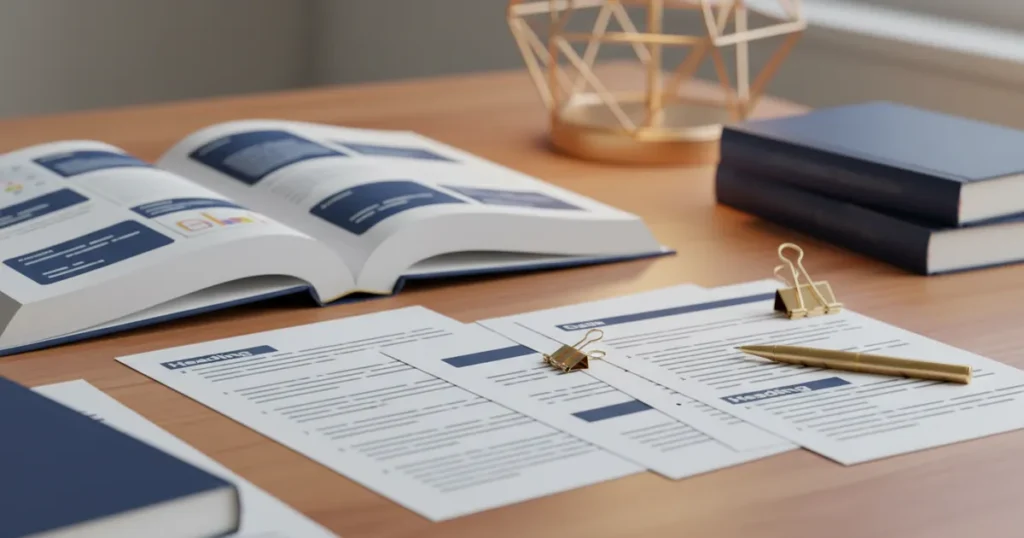
The first mistake many candidates make is jumping straight into the reading passage without fully digesting the list of headings provided. To master this task, you must treat the headings as your primary source of clues. In this section of The ultimate guide to matching headings, we look at how to dissect these short phrases to predict what the corresponding paragraphs will contain.
Understanding the Structure of a Heading
A heading is a summary of the main idea (the “gist”) of a paragraph. It is rarely a direct repetition of the words found in the text. Instead, it uses high-level vocabulary and abstract nouns to encapsulate a series of details. When you look at the list of headings, you should be looking for the “focus” and the “topic.” For example, if a heading is “The environmental impact of urban expansion,” the topic is “urban expansion” and the focus is the “environmental impact.” If you only look for “urban expansion,” you might choose the wrong paragraph if multiple sections discuss cities.
To improve your ability to spot these nuances, you should regularly review our IELTS reading tips and tricks, which explain how to distinguish between a paragraph’s supporting details and its central theme. The IELTS examiners often include “distractors”—headings that look correct because they contain a word from the paragraph but don’t actually summarize the entire section.
The Role of Paraphrasing
You cannot succeed in IELTS Reading without a solid grasp of synonyms. The heading might use the word “obstacles,” while the text uses “challenges,” “hindrances,” or “difficulties.” This is why we emphasize that paraphrasing is the ultimate IELTS skill, not just for writing, but for decoding reading headings as well. When you read the headings, try to think of 2-3 synonyms for the key words. This prepares your brain to recognize the concepts even when the vocabulary changes.
Key Concepts and Vocabulary for Matching Headings
To navigate the reading paper successfully, you need to understand the difference between global and local understanding. Matching headings requires global understanding—the big picture. This is different from “True, False, Not Given” questions, which usually require local understanding (specific details). In The ultimate guide to scoring a Band 8 or 9, we emphasize that you must stop reading every single word when matching headings.
Skimming and Scanning: The Dynamic Duo
Skimming is the act of reading a text quickly to get the general idea. For matching headings, you should skim the paragraph to find the topic sentence, which is often (but not always) the first or second sentence. Scanning, on the other hand, is looking for specific names, dates, or technical terms. While scanning is useful for many question types, skimming is your best friend for headings. You can find more practical exercises on these techniques in our IELTS Reading Lessons section.
Common Vocabulary Themes in Headings
IELTS headings often follow predictable patterns. Understanding these patterns can give you a significant advantage. Here are some common themes you will encounter:
- Cause and Effect: Headings like “The reasons for…” or “The consequences of…”
- Comparison/Contrast: Headings like “A different approach” or “Comparing two methods.”
- Chronology: Headings like “The early years,” “Future developments,” or “A historical perspective.”
- Problem and Solution: Headings like “Addressing the issue” or “A potential hurdle.”
- Statistical Data: Headings like “A surge in numbers” or “Declining trends.”
By identifying these functional patterns, you can match the “purpose” of the paragraph to the “purpose” of the heading. If a paragraph is full of dates and past tense verbs, a heading mentioning “history” or “origins” is a strong candidate. For more practice on these patterns, try our IELTS Reading Practice Tests to see how these themes appear in real exam scenarios.
Step-by-Step Strategy: The Ultimate Guide to Success
Success in this task is about having a repeatable system. You shouldn’t approach every paragraph differently; you need a consistent method that works under the pressure of the 60-minute time limit. According to the IELTS Official Website, the reading test is designed to assess a wide range of reading skills, and matching headings specifically tests your ability to identify the main message.
Step 1: Read the Headings First (Always!)
Don’t look at the passage yet. Read the list of headings and underline the keywords. Try to understand the difference between headings that seem similar. If Heading i is “The benefits of solar power” and Heading ii is “The economic advantages of renewable energy,” note that Heading i is specific to solar, while Heading ii is broader (renewable energy) and focused on money (economic).
Step 2: Start with the Easiest Paragraphs
You don’t have to do the paragraphs in order (A, B, C…). Some paragraphs are shorter or have very clear topic sentences. Start with those. As you match them, you can cross out the headings you’ve used, making the remaining choices easier. This is a core part of our IELTS Reading Strategies for time management.
Step 3: Read the First and Last Sentences
In academic writing, the first sentence usually introduces the main idea (topic sentence), and the last sentence often summarizes it or links to the next paragraph. If the answer isn’t clear from these, skim the middle. Look for transition words like “However,” “In addition,” or “Consequently,” as these signal a change or reinforcement of the main point.
Step 4: Don’t Get Stuck on One Paragraph
If two headings seem to fit Paragraph C, write both numbers down (e.g., iii or vi) and move on. Once you have read the rest of the passage, the correct answer for Paragraph C will often become obvious by the process of elimination. Time is your most valuable resource; don’t waste five minutes on a single mark.
IELTS Reading Score Conversion and Task Importance
Understanding how your reading marks translate to a band score can help you set realistic goals. Matching headings questions usually appear in groups of 5 to 7. Getting all of these right can significantly boost your score. Below is a general guide for the Academic Reading module.
| Correct Answers (out of 40) | IELTS Band Score | Proficiency Level |
|---|---|---|
| 39-40 | 9.0 | Expert |
| 37-38 | 8.5 | Very Good |
| 35-36 | 8.0 | Very Good |
| 33-34 | 7.5 | Good |
| 30-32 | 7.0 | Good |
| 27-29 | 6.5 | Competent |
| 23-26 | 6.0 | Competent |
Model Answer Walkthrough: Applying the Strategy
Let’s look at a practical example of how to apply The ultimate guide to matching headings in a real-world scenario. Imagine you have the following paragraph and a choice of three headings.
Paragraph: “While many believe that the primary benefit of remote work is the lack of a commute, recent studies suggest a more significant advantage: increased productivity. Employees working from home reported fewer interruptions from colleagues and a greater ability to focus on complex tasks for extended periods. Furthermore, companies have noted a marked decrease in overhead costs, such as electricity and office maintenance.”
Heading Options:
i. The financial benefits of office life
ii. Why working from home improves output
iii. The impact of commuting on employee health
Analysis:
Heading (i) is a distractor. It mentions “financial benefits,” which relates to “overhead costs,” but it says “office life” instead of “remote work.”
Heading (iii) is also a distractor. It mentions “commuting,” which is in the first sentence, but the paragraph isn’t about health; it’s about the benefits of not commuting.
Heading (ii) is the correct answer. “Improves output” is a paraphrase of “increased productivity,” which is the central theme of the paragraph.
The ultimate guide to common pitfalls and how to avoid them
Even the most prepared students can fall into traps set by the examiners. In this section of The ultimate guide to IELTS reading, we will highlight the most frequent errors and how you can train yourself to avoid them. Awareness is half the battle in the IELTS exam.
The “Word-Spotting” Trap
This is the most common mistake. A heading might contain the exact word “Sustainability,” and Paragraph B might mention “Sustainability” in the middle of a sentence. However, Paragraph B might actually be about “Government Policy.” The word “Sustainability” was just an example. Always ask yourself: “Is this paragraph about this heading, or does it just mention this word?” If it’s just a mention, it’s a distractor.
Over-reading and Over-thinking
Many students spend too much time reading the supporting details. Remember, the heading summarizes the main idea. If you find yourself reading about a specific case study of a bird in the Amazon, you are reading the details. Zoom out. Is that bird an example of “Endangered Species” or “Biodiversity in the Rainforest”? The heading will be the broader category.
“The secret to matching headings isn’t finding the answer; it’s proving why the other options are wrong. Once you eliminate the distractors that focus on minor details, the main idea becomes strikingly obvious.”
Senior IELTS Instructor at Simply IELTS
Actionable Tips for Your Daily Practice
To truly master this skill, you need to move beyond theory and into consistent practice. Here is a list of actionable steps you can take to improve your accuracy:
- Read Quality Journalism: Read articles from The Economist, BBC News, or National Geographic. After reading a paragraph, cover it up and try to write your own one-sentence heading.
- Analyze Your Errors: When you get a matching heading question wrong, don’t just look at the correct answer. Go back and find the “distractor” word that tricked you. Understanding why you were wrong is more important than knowing you were wrong.
- Time Yourself: Give yourself exactly 2 minutes to match 5 headings. This forces you to stop over-reading and start skimming for main ideas.
- Expand Your Vocabulary: Keep a “Synonym Journal.” When you find a new word in a reading passage, write down its synonyms and antonyms.
- Use Official Materials: Practice with authentic Cambridge IELTS papers to get a feel for the real level of difficulty and the types of distractors used.
- Focus on Topic Sentences: Practice identifying the topic sentence in every paragraph you read, even outside of IELTS materials.
- Check Your Work: Once you have finished all headings for a passage, read your chosen headings in order. They should form a logical summary or “story” of the whole text.
Conclusion and Next Steps
Mastering the matching headings task is a journey of shifting your focus from individual words to overall meaning. We hope The ultimate guide to IELTS reading matching headings has provided you with the clarity and tools you need to tackle your next practice test with a new perspective. Remember, the key is to stay calm, use the process of elimination, and always look for the “gist” rather than the detail.
If you found this guide helpful, don’t stop here! Your IELTS preparation should be holistic. Explore our other resources, such as our IELTS Reading Practice Tests to put these strategies into action. For those who want personalized feedback and a structured path to a Band 7+, our IELTS Reading Course is designed to take you from confused to confident in just a few weeks. Keep practicing, stay focused, and you will achieve the score you deserve. Good luck!




Responses