
IELTS Academic vs General Writing Task 1: Key Differences 2026

Navigating the IELTS journey often begins with a fundamental choice: Academic or General Training. While both modules share the same Listening and Speaking tests, the Writing section presents a significant divergence. Understanding the ielts academic vs general writing task 1: key differences 2026 is not just a matter of curiosity; it is a strategic necessity for anyone aiming for a Band 7.0 or higher. The requirements for describing a complex data set are worlds apart from crafting a formal or informal letter, and applying the wrong set of skills can lead to a disappointing score.
For Academic candidates, Task 1 is a test of your ability to identify trends, compare data, and use precise, objective language. For General Training candidates, it is a test of your social and professional communication skills through letter writing. Mastering these specific skills is crucial because Task 1 accounts for one-third of your total Writing score. A high-scoring report or letter sets a positive tone for your examiner before they even move on to Task 2. In this guide, we will break down the structural, linguistic, and strategic differences you need to succeed in 2026.
Whether you are analyzing a line graph or writing to a landlord, the underlying principles of clarity, coherence, and grammatical range remain constant. By the end of this post, you will have a clear roadmap for your specific module, backed by data-driven examples and expert strategies used by top-scoring students at SimplyIELTS.
Understanding the Task: Academic vs General Training
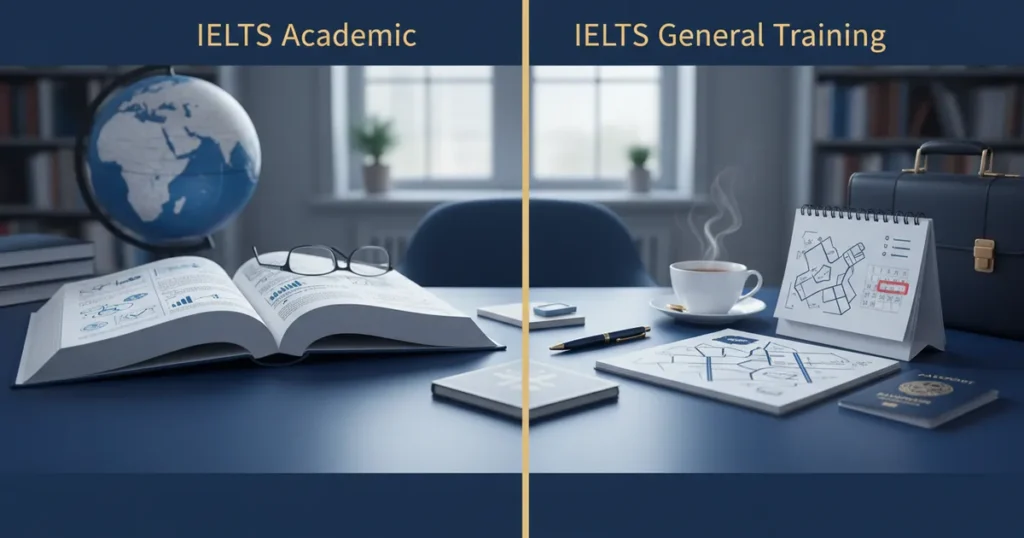
The most striking difference between the two modules is the prompt itself. In the Academic module, you are presented with a visual representation of information—a bar chart, line graph, pie chart, table, map, or flow chart. Your job is to “summarise the information by selecting and reporting the main features.” In the General Training module, you are given a situation and asked to write a letter (formal, semi-formal, or informal) to a person, company, or institution. You must address three specific bullet points provided in the prompt.
The IELTS Official Website emphasizes that while the tasks differ, the assessment criteria are identical in name but different in application. Below is a breakdown of how examiners evaluate both tasks to award a Band 9 score.
| Criterion (25% each) | Academic Band 9 Requirements | General Training Band 9 Requirements |
|---|---|---|
| Task Achievement | Fully satisfies all requirements; provides a clear overview; highlights key features and trends accurately. | Fully addresses all three bullet points; the purpose of the letter is clear; the tone is consistent and appropriate. |
| Coherence & Cohesion | Uses a wide range of cohesive devices naturally; information is logically sequenced; paragraphs are used effectively. | The message flows logically; transitions between bullet points are seamless; paragraphing is clear and logical. |
| Lexical Resource | Uses a wide range of sophisticated, objective vocabulary; precise data description; no errors in spelling or word formation. | Uses a wide range of vocabulary suitable for the specific context/tone (formal vs. informal); natural use of collocations. |
| Grammatical Range & Accuracy | Uses a wide range of complex structures (e.g., passive voice) with full flexibility and accuracy. | Uses a variety of complex sentence forms; maintains high accuracy; punctuation is used correctly throughout. |
Strategy / Step-by-Step Guide: How to Approach Task 1
Regardless of your module, success in Task 1 requires a disciplined approach. You have exactly 20 minutes to complete this task, so efficiency is key. Follow these three essential steps to ensure you cover all bases for a high band score.
Step 1: Analyse and Plan (2-3 Minutes)
For Academic students, this means looking at the axes, the legend, and the units of measurement. Identify the “big picture”—is everything increasing? Is there a clear contrast? For General Training students, identify the purpose (complaint, request, apology) and the relationship with the recipient to determine the tone. If you are writing to a friend, your language should be informal; if you are writing to a manager, it must be formal.
Step 2: Write the Introduction and Overview/Purpose (5 Minutes)
In the Academic report, your introduction paraphrases the prompt. This should be followed immediately by an Overview, which is the most critical part of your essay. Without a clear overview of the main trends, you cannot score above a Band 5 for Task Achievement. In the General Training letter, your first sentence must state the purpose of the letter clearly (e.g., “I am writing to express my dissatisfaction with…” or “I’m just writing to let you know…”).
Step 3: Detail Paragraphs (10-12 Minutes)
In the Academic module, group your data logically. Do not describe every single point; instead, use comparison language to show how categories relate to one another. For General Training, dedicate one paragraph to each bullet point. Ensure you expand on the points with realistic details to make the letter convincing, but stay on topic.
Practice Task: Sample IELTS Writing Task 1 Prompt
The table below shows the number of international visitors (in millions) to three major London museums between 2015 and 2024. Summarise the information by selecting and reporting the main features, and make comparisons where relevant.
| Year | British Museum (Millions) | Science Museum (Millions) | Natural History Museum (Millions) |
|---|---|---|---|
| 2015 | 6.82 | 3.35 | 4.59 |
| 2018 | 6.24 | 3.12 | 5.22 |
| 2021 | 2.31 | 1.15 | 1.78 |
| 2024 | 7.14 | 3.48 | 5.56 |
(Note: This is a hypothetical dataset created for practice purposes, modelled on authentic IELTS exam formats.)
Band 9 Model Answer
The provided table illustrates the fluctuations in international visitor numbers for three prominent London museums—the British Museum, the Science Museum, and the Natural History Museum—over a nine-year period starting in 2015.
Overall, all three institutions experienced a significant decline in attendance by 2021, followed by a robust recovery in 2024. The British Museum remained the most popular destination throughout the period, while the Natural History Museum showed the most consistent long-term growth.
In 2015, the British Museum led with 6.82 million visitors, significantly outperforming the Natural History Museum (4.59 million) and the Science Museum (3.35 million). By 2018, while the British Museum and Science Museum saw slight decreases to 6.24 and 3.12 million respectively, the Natural History Museum grew to 5.22 million. However, by 2021, figures for all three plummeted, with the Science Museum hitting a low of 1.15 million and the British Museum dropping to 2.31 million.
By 2024, a sharp reversal occurred. The British Museum reached a peak of 7.14 million visitors. Similarly, the Natural History Museum and Science Museum recovered to 5.56 million and 3.48 million respectively, both exceeding their initial 2015 levels.
Why This Scores Band 9
- Task Achievement: The response provides a comprehensive overview of the main trends (the 2021 dip and 2024 recovery) and highlights specific data points (e.g., 7.14 million for the British Museum).
- Coherence and Cohesion: The use of transition signals like “Overall,” “In 2015,” “However,” and “Similarly” ensures a logical flow of information.
- Lexical Resource: The author uses varied trend language such as “plummeted,” “robust recovery,” and “outperforming.”
- Grammatical Range: The answer employs a mix of simple and complex sentences, including participle phrases (“starting in 2015”) and comparative structures (“more popular… than”).
Vocabulary and Phrases Bank
To excel in the ielts academic vs general writing task 1: key differences 2026, you must build a repository of module-specific vocabulary. Use the table below to master these essential terms.
| Word/Phrase | Usage (Module) | Example with Data/Context |
|---|---|---|
| Plummeted | Academic (Trends) | Visitor numbers plummeted to a low of 1.15 million in 2021. |
| Marginal increase | Academic (Trends) | There was a marginal increase in Science Museum visitors between 2015 and 2024. |
| I am writing to enquire | General (Formal) | I am writing to enquire about the availability of the conference room. |
| Give my best to… | General (Informal) | Give my best to your family when you see them next week. |
| Respectively | Academic (Data) | The figures were 7.14 and 5.56 million for the British and Natural History museums, respectively. |
| In stark contrast | Academic (Comparison) | In stark contrast to the British Museum, the Science Museum saw lower attendance. |
| Apologise for any inconvenience | General (Formal) | I would like to apologise for any inconvenience this delay may have caused. |
| A significant recovery | Academic (Trends) | 2024 saw a significant recovery in international tourism. |
| Drop me a line | General (Informal) | Drop me a line when you have a moment to chat. |
| Peak at | Academic (Trends) | Attendance figures peaked at 7.14 million in the final year. |
Grammar Focus: Structures for This Task Type
Grammar is the skeleton of your writing. In the Academic module, you need to master the passive voice and complex comparisons. In General Training, the focus shifts to the correct use of tenses (past for complaints about events, future for requests/plans) and modal verbs for politeness.
- Comparative Structures: “The British Museum attracted nearly double the number of visitors as the Science Museum in 2024 (7.14m vs 3.48m).”
- Passive Voice for Processes: If describing a flow chart, you would write: “The data is collected before it is analyzed by the software.”
- Past Perfect for Time Sequences: “By the time 2024 arrived, the Natural History Museum had already surpassed its 2018 peak of 5.22 million.”
- Modal Verbs (General Training): “I would be grateful if you could provide a refund for the damaged goods.”
- Participle Clauses: “Visitor numbers fell sharply in 2021, reaching a low of 1.15 million at the Science Museum.”
- Complex Conditionals (General Training): “If the issue is not resolved by Friday, I will be forced to take further action.”
Common Mistakes and How to Fix Them
Many students lose marks by applying the wrong logic to their specific module. Here are the most frequent errors observed in 2026.
- Mistake 1: Giving Opinions (Academic). Never explain why you think the data changed (e.g., “Numbers dropped in 2021 because of the pandemic”). Correction: Only report what is visible in the chart.
- Mistake 2: Inconsistent Tone (General). Mixing informal slang with formal sign-offs (e.g., “Hey Sir, Yours sincerely”). Correction: Match the greeting, body, and sign-off to the recipient.
- Mistake 3: No Overview (Academic). Jumping straight into details without a summary. Correction: Always include an “Overall” statement describing the main trend.
- Mistake 4: Missing Bullet Points (General). Forgetting to address one of the three prompts. Correction: Check off each bullet point as you write.
- Mistake 5: Listing Every Number (Academic). Writing a list of data instead of a report. Correction: Group data and use comparison language to highlight relationships.
Quick Reference Checklist
Before you submit your Task 1 response, run through this checklist to ensure you meet the Band 7+ criteria.
| Checklist Item | Academic | General Training |
|---|---|---|
| Introduction | Did I paraphrase the prompt correctly? | Is the purpose of the letter clear in the first paragraph? |
| Overview/Tone | Is there a clear “Overall” summary? | Is the tone consistent (formal or informal) throughout? |
| Data/Details | Did I include specific numbers to support my points? | Did I address all three bullet points in the prompt? |
| Comparison | Did I compare the different categories/years? | Did I use appropriate opening and closing salutations? |
| Word Count | Is it at least 150 words? | Is it at least 150 words? |
| Grammar | Did I use a variety of tenses and complex structures? | Are my tenses accurate for the context of the letter? |
Conclusion: Your Path to Writing Success
The journey to a Band 9 in IELTS Writing Task 1 depends on your ability to adapt to the specific demands of your module. While the ielts academic vs general writing task 1: key differences 2026 might seem daunting at first, they essentially boil down to how you process and present information. Academic candidates must become data storytellers, using objective language to describe trends. General Training candidates must become effective communicators, using the right tone to achieve a social or professional goal.
Practice is the only way to internalize these strategies. Start by attempting our IELTS Practice Tests and comparing your work to our model answers. If you are struggling with specific chart types, check out our in-depth guide on how to describe a bar chart or explore our premium IELTS courses for personalized feedback. Remember, every data point you analyze and every letter you write brings you one step closer to your target score. Keep practicing, stay focused, and you will see the results on your exam day.






Responses