
Computer-Delivered IELTS vs Paper-Based: Which Should You Choose?

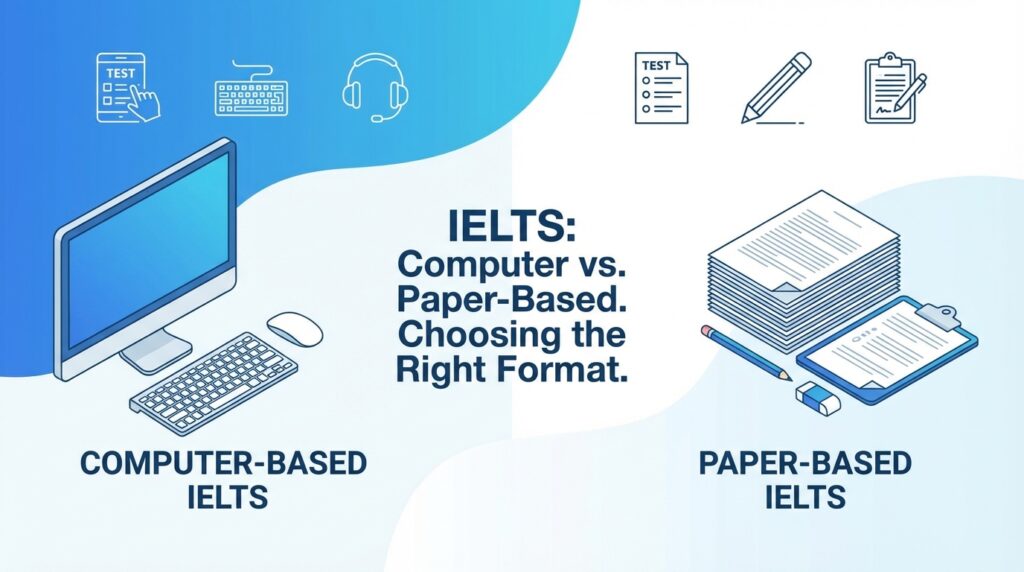
One of the first decisions you’ll make when booking your IELTS test is choosing between computer IELTS vs paper format. Both versions test the same skills and produce identical scores, but the experience differs significantly. This comprehensive guide helps you understand the key differences and make the right choice for your learning style.
Understanding the Two Formats
IELTS is available in two delivery formats:
- Paper-based IELTS (PBT): The traditional format where you write answers on paper answer sheets
- Computer-delivered IELTS (CDI): The modern format where you type answers on a computer
Both formats are administered in official test centres and follow the same structure, timing, and marking criteria. The Speaking test is always conducted face-to-face with a certified examiner, regardless of which format you choose.
Key Differences at a Glance
| Feature | Computer-Delivered | Paper-Based |
|---|---|---|
| Results Time | 3-5 days | 13 days |
| Test Availability | Multiple times daily | 4 times monthly |
| Writing Method | Keyboard typing | Handwriting |
| Reading Navigation | Split screen | Physical booklet |
| Listening | Headphones | Speakers |
| Word Count | Automatic display | Manual counting |
| Test Environment | Individual workstations | Exam hall |
Advantages of Computer-Delivered IELTS
1. Faster Results
This is the biggest advantage for many candidates. Computer-delivered IELTS results are released within 3-5 days, compared to 13 days for paper-based tests. If you have tight deadlines for university applications or visa submissions, CDI is often the better choice.
2. More Test Dates Available
Computer-delivered tests run multiple times per day, up to 7 days a week at major test centres. This flexibility means:
- Easier scheduling around your commitments
- More opportunities if you need to retake
- Shorter waiting times to book your preferred date
3. Automatic Word Count
For the Writing section, a word counter displays your progress in real-time. This eliminates the stress of counting words manually and helps you manage your time more effectively.
4. Easy Editing
Typing allows you to easily:
- Delete and rewrite sentences
- Copy and paste text
- Reorganise paragraphs
- Make corrections without messy crossings-out
5. Individual Audio
The Listening test uses headphones, giving you:
- Personal volume control
- Clearer audio quality
- No distractions from other candidates
6. Split-Screen Reading
During the Reading test, questions appear alongside the passage, eliminating the need to flip between pages.
Advantages of Paper-Based IELTS
1. Familiar Format
If you’re more comfortable with traditional exams and handwriting, paper-based IELTS might feel more natural. Many candidates have spent years taking written exams and prefer this established format.
2. No Typing Required
If you’re not a confident typist, handwriting eliminates concerns about:
- Typing speed
- Keyboard familiarity
- Technology anxiety
3. Physical Note-Taking
Some candidates prefer writing notes by hand during the Listening and Reading tests. Paper-based format allows more natural underlining, circling, and annotation.
4. Tactile Reading Experience
Reading from paper can feel more comfortable for some people, allowing them to:
- Physically mark passages
- Move between questions more intuitively
- Avoid screen fatigue
5. No Technology Issues
While rare, technical problems can occur with computers. Paper-based tests eliminate this concern entirely.
Section-by-Section Comparison
Listening Section
Computer-Delivered:
- Wear headphones with personal volume control
- Type answers directly into text boxes
- 30 minutes of listening time (no extra transfer time)
- Navigate between questions within each section
Paper-Based:
- Audio played through speakers in the room
- Write answers on the question booklet, then transfer to answer sheet
- 30 minutes listening + 10 minutes transfer time
- Traditional pencil-and-paper experience
For comprehensive listening strategies, check our 9 Band Secrets to Master IELTS Listening.
Reading Section
Computer-Delivered:
- Split screen shows passage and questions simultaneously
- Highlighting and note-taking tools available
- Click to move between passages
- Review feature to flag questions for checking
Paper-Based:
- Physical booklet with passages and questions
- Underline and annotate freely on paper
- Transfer answers to separate answer sheet
- Flip pages to navigate between sections
Writing Section
Computer-Delivered:
- Type essays using a standard keyboard
- Automatic word count displayed
- Cut, copy, paste functions available
- Easy to edit and restructure
Paper-Based:
- Handwrite essays in pen
- Count words manually
- Corrections require crossing out
- Neat handwriting important for readability
Speaking Section
The Speaking test is identical in both formats. You’ll have a face-to-face conversation with a certified examiner lasting 11-14 minutes. The only difference is that computer-delivered candidates typically take the Speaking test within a few days of their other sections.
Which Format is Right for You?
Consider choosing computer-delivered IELTS if:
- You’re comfortable typing quickly and accurately
- You need results urgently (visa deadlines, application dates)
- You prefer editing text on screen
- You want more flexibility in scheduling
- You’re used to computer-based work or study
Consider choosing paper-based IELTS if:
- You’re not a confident typist
- You prefer handwriting for extended writing tasks
- You have time for the longer results period
- You’re more comfortable with traditional exam formats
- You find screen reading tiring
Preparing for Computer-Delivered IELTS
If you choose the computer format, here’s how to prepare:
1. Improve Your Typing Skills
Aim for at least 30-40 words per minute to complete the Writing tasks comfortably. Practice typing regularly before your test date.
2. Take Practice Tests Online
Familiarise yourself with the computer interface using:
3. Practice Reading on Screen
Get comfortable reading longer texts on a computer. Practice summarising and taking notes from digital sources.
4. Master the Interface
Understand how to:
- Navigate between questions
- Highlight text
- Use the review function
- Adjust volume during Listening
Preparing for Paper-Based IELTS
If you choose the paper format, focus on:
1. Handwriting Speed and Legibility
Practice writing quickly while maintaining readable handwriting. Examiners must be able to read your answers clearly.
2. Answer Sheet Accuracy
Practice transferring answers correctly to the answer sheet. Mistakes in transfer can cost valuable marks.
3. Word Counting
Develop quick methods for counting words (e.g., count words per line and multiply).
4. Time Management
Account for transfer time in Listening and ensure you complete all questions within the time limit.
Common Concerns Addressed
“Will computer IELTS be harder?”
No. Both formats have identical difficulty levels and are marked using the same criteria. Statistical analysis ensures scores are equivalent regardless of format.
“What if I’m a slow typist?”
Consider paper-based, or invest time improving your typing before the test. You need to comfortably type 400+ words in 60 minutes for the Writing section.
“What happens if there’s a technical problem?”
Test centres have backup systems and protocols. If issues occur, your test time may be extended or you may be rescheduled at no additional cost.
“Can I use spell-check on computer IELTS?”
No. Spell-check, grammar check, and autocorrect are disabled. You must rely on your own spelling and grammar knowledge.
Cost Comparison
Both formats typically cost the same. Prices vary by location but generally range from £185-£210 for standard IELTS. However, consider:
- Computer-delivered tests may offer more competitive pricing in some regions
- If you need to retake, the IELTS One Skill Retake option is available for both formats
Making Your Decision
To decide between the formats:
- Assess your typing ability: Can you type 40+ words per minute comfortably?
- Consider your timeline: Do you need results quickly?
- Reflect on your test-taking preferences: How have you performed in previous exams?
- Take practice tests in both formats: Experience each before deciding
Preparing for IELTS Success
Regardless of which format you choose, focus on:
- Building strong English language skills across all four areas
- Understanding the test format and question types
- Practising with authentic IELTS materials
- Developing effective time management strategies
Learn more about effective preparation with the best way to prepare for the IELTS exam.
Vocabulary and Language Tips
Strong vocabulary helps regardless of format. Explore our 5 effective tips to improve your vocabulary for better performance in all sections.
Conclusion
When comparing computer IELTS vs paper, there’s no objectively “better” format—only the format that’s better for you. Both produce equally valid results and are accepted by all institutions that accept IELTS scores.
Consider your personal preferences, typing ability, and timeline requirements. If possible, try sample tests in both formats before booking. Whatever you choose, thorough preparation remains the key to achieving your target band score.
Remember, you can always use the One Skill Retake option if you need to improve a specific skill, regardless of which format you initially chose.




Responses